Alibaba Launched Qwen4-Max at $1.67 a Task.
The price per token fell. The price per task is the number to route on.

Alibaba's Qwen team released Qwen4-Max on 16 November. It is the first model on the new Qwen4 architecture: a 2.4-trillion-parameter backbone with 71 billion parameters active per token, a one-million-token context window and native vision.
The number Qwen leads with is not a benchmark score. It is a bill. On Work360, the average cost per task drops from $4.43 on Qwen3.8-Max to $1.67 on Qwen4-Max, which Qwen puts at 62% below the old model.
Work360 is Qwen's own benchmark. The team built it in-house from a taxonomy of 26 domains, 182 subdomains and 721 specialised fields, and Qwen4-Max scores 52.69 on it against 47.74 for Qwen3.8-Max. That makes the $1.67 a real measurement on someone else's tasks. Yours are the ones that count.
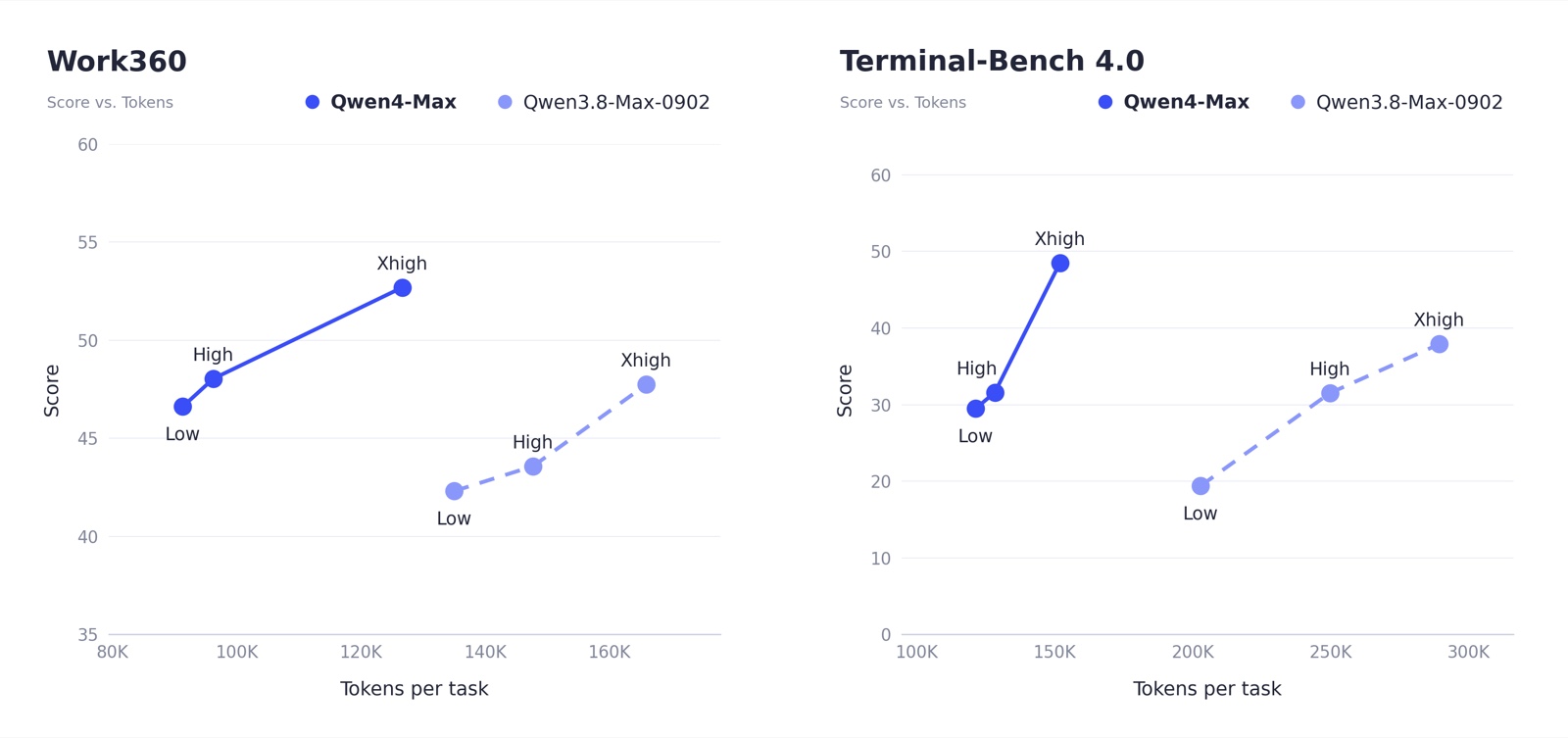
Token-efficiency chart from Qwen's Qwen4-Max launch post. Qwen ran both benchmarks and chose the comparison.
The token got cheaper. The task got cheaper faster.
Two things moved at once. The list price came down: on OpenRouter, Qwen4-Max costs $1.50 per million input tokens and $4.50 per million output, down from $2.00 and $6.00 for Qwen3.8-Max-0902. Cached input fell furthest, to $0.075 from $0.25.
And the model uses fewer tokens to finish. Qwen reports token use on Work360 down about 24% at Xhigh effort and 35% at High. On Terminal-Bench 4.0 the cuts are about 48% and 49%.
A per-token price sees only the first of those. The cost of a finished task sees both, which is why the price per token fell less than the price per task.
Whose tasks?
Artificial Analysis, which runs the same nine evaluations across every model in its index, puts Qwen4-Max at 43 on its Intelligence Index and $3.27 per task. That is a different set of tasks from Work360, so the two dollar figures do not contradict each other. They answer different questions.
On Artificial Analysis's tasks Qwen4-Max costs less than Kimi K3.1 Pro and Opus 5.5, at $3.68 and $10.04. GPT-6.1 Sol at Max costs less per task and scores higher: $1.27 and 55 points. Artificial Analysis also calls Qwen4-Max very verbose. Running the index it generated 127 million output tokens, more than the median of 65.4 million. A cheap token used freely is not a cheap task.
Where the cheap task is
Qwen's own comparison chart says the same thing in another way. On Agents' Last Exam, the long-horizon work test, Qwen4-Max scores 46.7 against 43.4 for Opus 5.5. On Terminal-Bench 4.0, the coding agent's test, it scores 48.5, behind Opus 5.5 and Kimi K3.1 at 59.6 and 67.2.
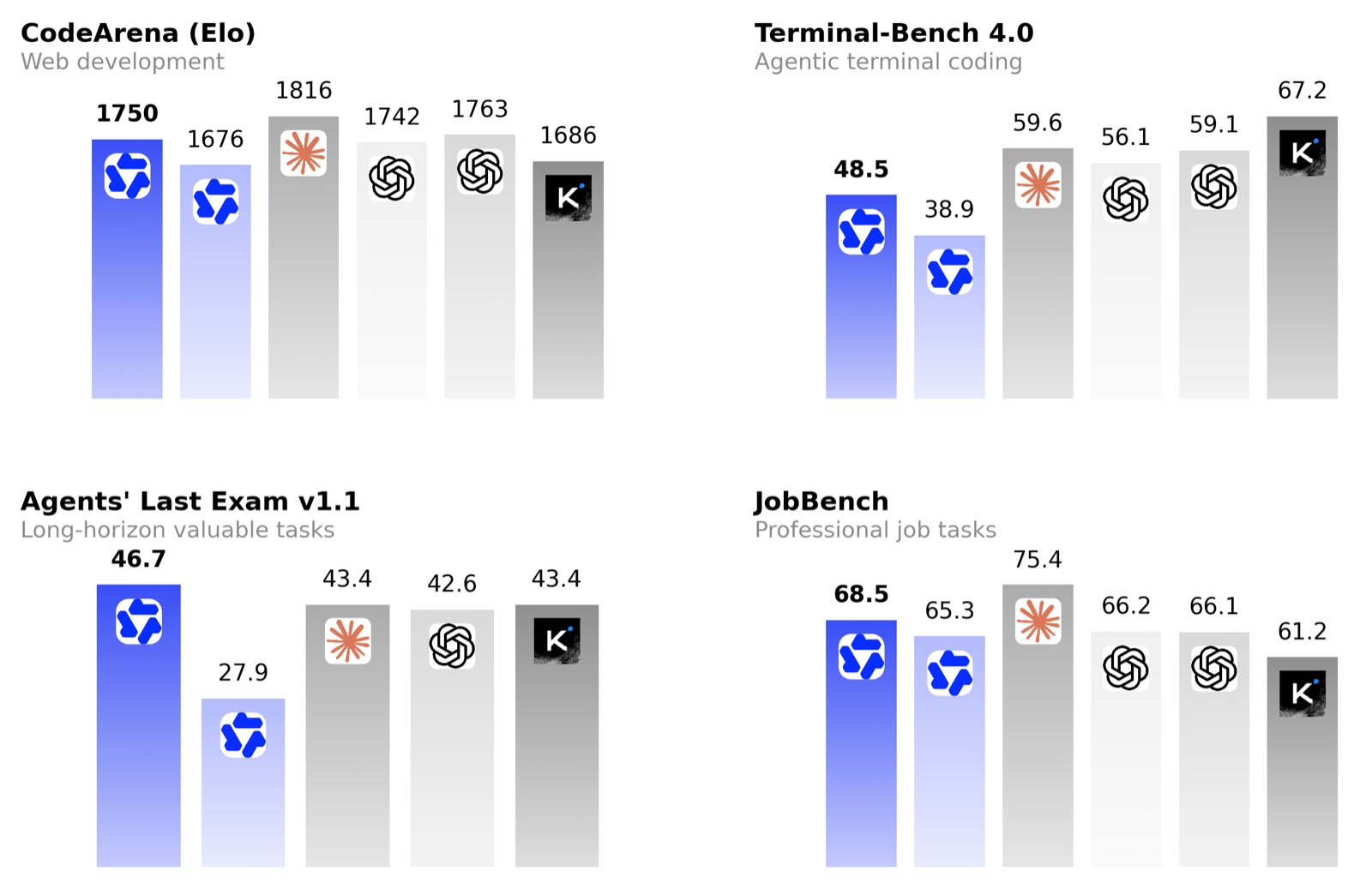
Four of sixteen panels from the comparison chart in Qwen's launch post. Qwen ran its own models; its footnotes say some rival scores are cited from public leaderboards.
Read together, the pitch is narrower than "your new teammate". Qwen4-Max is a candidate for long office and research jobs, the kind Qwen shows off with an 86-page due-diligence report and a machined car part whose manual programming time, Qwen says, fell from about 475 minutes to 24. It is not the obvious pick to drive a terminal.
Test it this week
If your company runs agent work in bulk, the cost of a finished task is the number to route on, and only your tasks can produce it. Qwen's $1.67 is on Qwen's tasks. Artificial Analysis's $3.27 is on theirs.
Pull 20 finished jobs. Take them from your logs, from the work you would hand an agent tomorrow: reports, research, document review. Keep the inputs and the accepted output.
Run them three ways. Qwen4-Max at High, Qwen4-Max at Xhigh, and the model you use now. It is live on OpenRouter, so this is a model-name change, not a contract.
Divide the bill by the passes. Total spend over jobs that passed your own review. Tokens per job and price per token are inputs to that number, not substitutes for it. Fable 5.2 showed the opposite case: cheaper per token, dearer per job.
Keep coding agents where they are until a terminal test says otherwise. Google's answer to the same problem was to split planning from typing across two models, and Carbon's price doubles on 1 December. A per-task sheet makes every one of those choices a lookup.
Price the task.

Founder of nativefirst.ai. Runs everything on agents and writes down what works.