Google Gemini 4 Hydrogen: First Reactions
Independent scores arrived three minutes after Google's announcement.
Google shipped Gemini 4 Hydrogen on 12 November, the fast model in the Gemini 4 family. It went straight into Search, the Gemini app, the API and Antigravity. Three minutes after Google's own account announced it on X, Artificial Analysis had published independent scores. By the end of the launch day Plotly had put it through a private exam, and the two Hacker News threads have since collected 572 and 506 points.
Here is what those people found, in order, and what each finding is good for. It starts with the man whose lab built it.

Hassabis
"Very excited to release Gemini 4 Hydrogen! Incredible speed and intelligence for everyday coding, agentic work and all-round use. I think you'll love this model."
Read the order of the words. Speed comes before intelligence, and every use he lists is an everyday one. Google is not selling Hydrogen as its smartest model. That job belongs to Carbon, and the rest of the launch explains how the two are meant to share the work.
Google's own people led with the pairing
Logan Kilpatrick, who works on Gemini, Google AI Studio and the Gemini API, posted the availability list at 18:05 UTC: every tier of AI Studio and the API, Gemini for business, the Gemini app, Google Search, and paid AI Pro and Ultra subscribers in Antigravity. Within two minutes Google's Gemini account added that free users get Hydrogen through auto model selection. For most people, their first Gemini 4 answer will come from this model.
Thirty-four seconds after Kilpatrick, Varun Mohan, who builds Antigravity at Google DeepMind, posted the part builders should care about. Orchestrator, a new entry in Antigravity's model menu, lets Carbon and Hydrogen share one task. He said it used 24% less quota and finished the same tasks 19% faster, and that pairing Hydrogen with Orchestrator and with swarms of agents had become very popular inside Google.
Clement Farabet, who works on Gemini at Google DeepMind, put the division of labour in one line at 18:18 UTC: Carbon for the architecture, Hydrogen for the fast repository edits and execution.
All three are the vendor talking. They are worth reading for one reason. On launch day Google's engineers led with the pairing, not with the model on its own.
The first independent numbers, three minutes in
Artificial Analysis, which runs its own evaluations across every major model, posted at 18:07 UTC. It confirmed the figure Google leads with: Hydrogen at its default high setting scores 51 on the Artificial Analysis Intelligence Index. Then it added two numbers Google's launch post does not lead with.
The good one is about making things up. On AA-Omniscience, which tests whether a model invents an answer when it does not know, Hydrogen has one of the lowest hallucination rates Artificial Analysis has recorded: 8%, against 43% for Claude Sonnet 5.5 at max effort. For any job where a wrong answer costs more than no answer, that gap matters more than a point on an index.
The weak one is the terminal. On Terminal-Bench 4.0, Artificial Analysis measured Hydrogen at 54%, with Sonnet 5.5 ahead at the terminal on 64%. Turning Hydrogen up to xhigh did not move that score at all. It is the same result Google's own table shows, from a source that does not sell the model.
Artificial Analysis also priced the work. One task on its index costs $1.87 at Hydrogen's high setting and $3.16 at xhigh, for the move from 51 to 54. Start on high.
Plotly gave it an exam
Plotly, the charting company, ran Hydrogen through DataAnalyticsBench, its private 43-question data analysis exam, on launch day. Hydrogen answered 43 of 43 for $6.36 a run, the fourth model to get a perfect score after GPT-6 Astra, GPT-6.1 Sol and Claude Fable 5.2. Plotly's co-founder Chris Parmer shared the result in the Orchestrator thread on Hacker News.
Two other lines in Plotly's table are more useful than the perfect score. Gemini 4 Carbon scored 42 of 43 for $11.55, so Google's frontier model got one question fewer for nearly twice the money. And GPT-6.1 Sol got the same perfect score for less: $2.61. Plotly's own reading is that Hydrogen sits just off the frontier of score against cost.
So one independent exam says two things at once. On this kind of work Hydrogen beats Google's own big model on price, and it is not the cheapest way to a perfect score.
What Hacker News argued about
The launch thread reached 572 points by 16 November. Its largest sub-thread by far was about the name. Hydrogen, Argon and Carbon run in neither alphabetical nor atomic order, and commenters including jawns and lbarrow set out the orderings Google did not pick. It is not a technical finding, but it is the first thing a new user meets in the model picker.
Under the jokes were three findings worth keeping.
The failures are in the tail. One commenter who describes being a big Gemini fan said the first runs with Hydrogen and Carbon were disappointing: better single-pass scores, but worse failures at the 90th and 99th percentile of agent runs. Doing more than was asked, working on when it should have failed fast, doing something unrelated. That is one user's experience, not a measurement, and it is exactly the failure a benchmark table cannot show.
The front-end work is good. jjcm, who says he spent about five years at Figma, published side-by-side image-to-HTML builds from Hydrogen and Sonnet 5.5. He placed Hydrogen between Sonnet and Opus on that task, and level with GPT Sol.
Builders are wary of letting the model choose. In the Orchestrator thread, which reached 506 points by 16 November, a developer who already runs sub-agents said they pin each one to a model by how hard they judge the problem, and are nervous about handing that call to a model, because models tend to be optimistic about their own abilities. A fixed easy implementer and a fixed hard implementer, they added, is trivial to set up.
What Google published
The launch post is signed by Koray Kavukcuoglu, the SVP of Google DeepMind and Google's Chief AI Architect. Hydrogen costs $1.50 per million input tokens and $7.50 per million output, flat across a one-million-token context window. Gemini 4 Argon, which the same post calls a frontier model, scores 50 on the Intelligence Index, so the fast model sits one point above Argon.
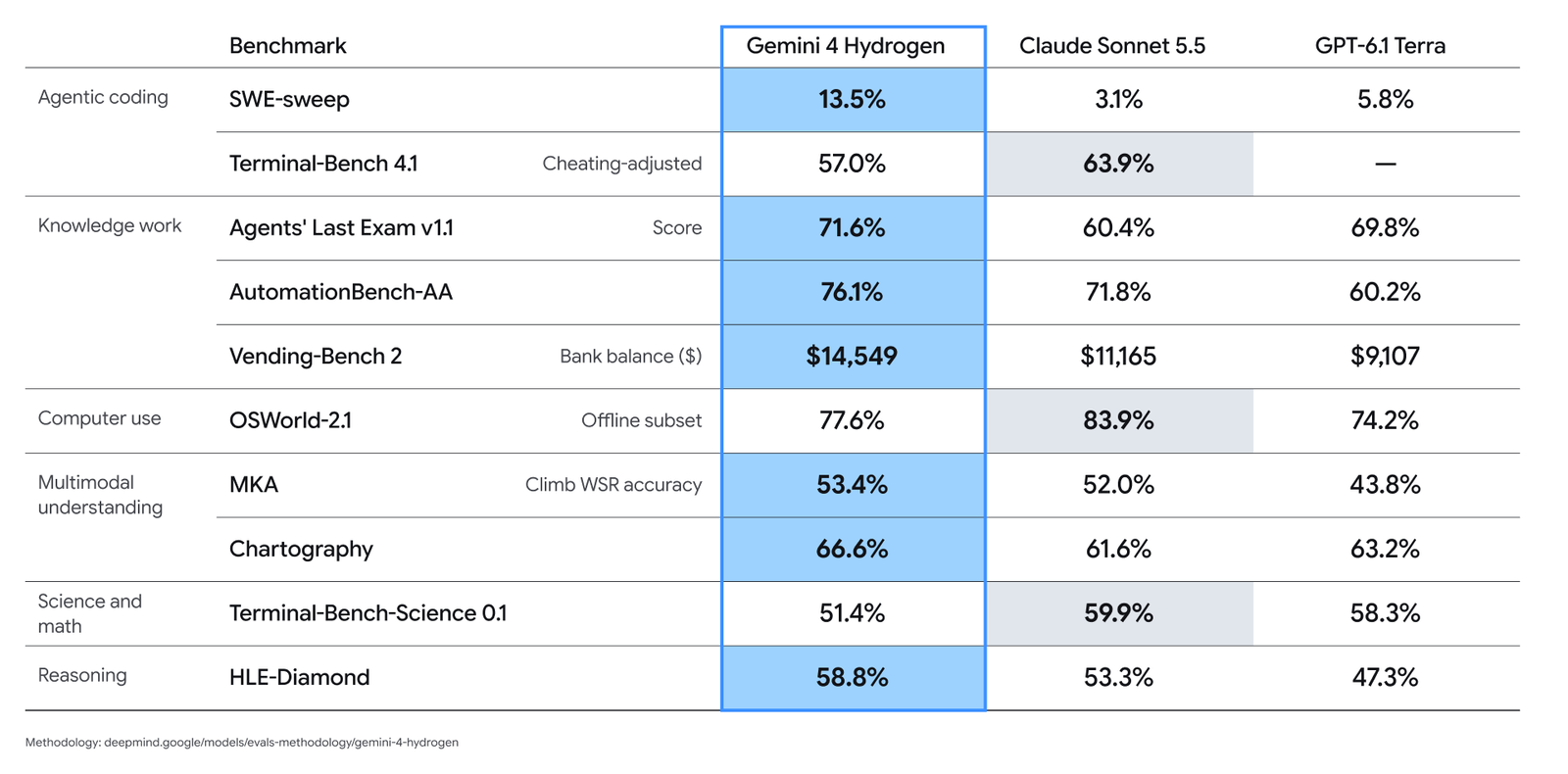
Benchmark table from Google's launch post and model card. Google chose the comparison columns.
Google picked the opponents: Claude Sonnet 5.5 and GPT-6.1 Terra, the mid-priced models from Anthropic and OpenAI. Even on that ground the table splits. Hydrogen is ahead on the knowledge-work rows. It scores 71.6% on Agents' Last Exam against 60.4% for Sonnet, and 76.1% on AutomationBench-AA against 71.8%.
Sonnet 5.5 is ahead on three rows, and they are the rows a coding agent lives on. Terminal-Bench 4.1 goes 63.9% to 57.0%. OSWorld-2.1, the computer-use test, goes 83.9% to 77.6%. Terminal-Bench-Science goes 59.9% to 51.4%.
So the vendor's own table says Hydrogen is strong at office work and second at driving a terminal. Hold that thought, because driving a terminal is the job Google then hands it.
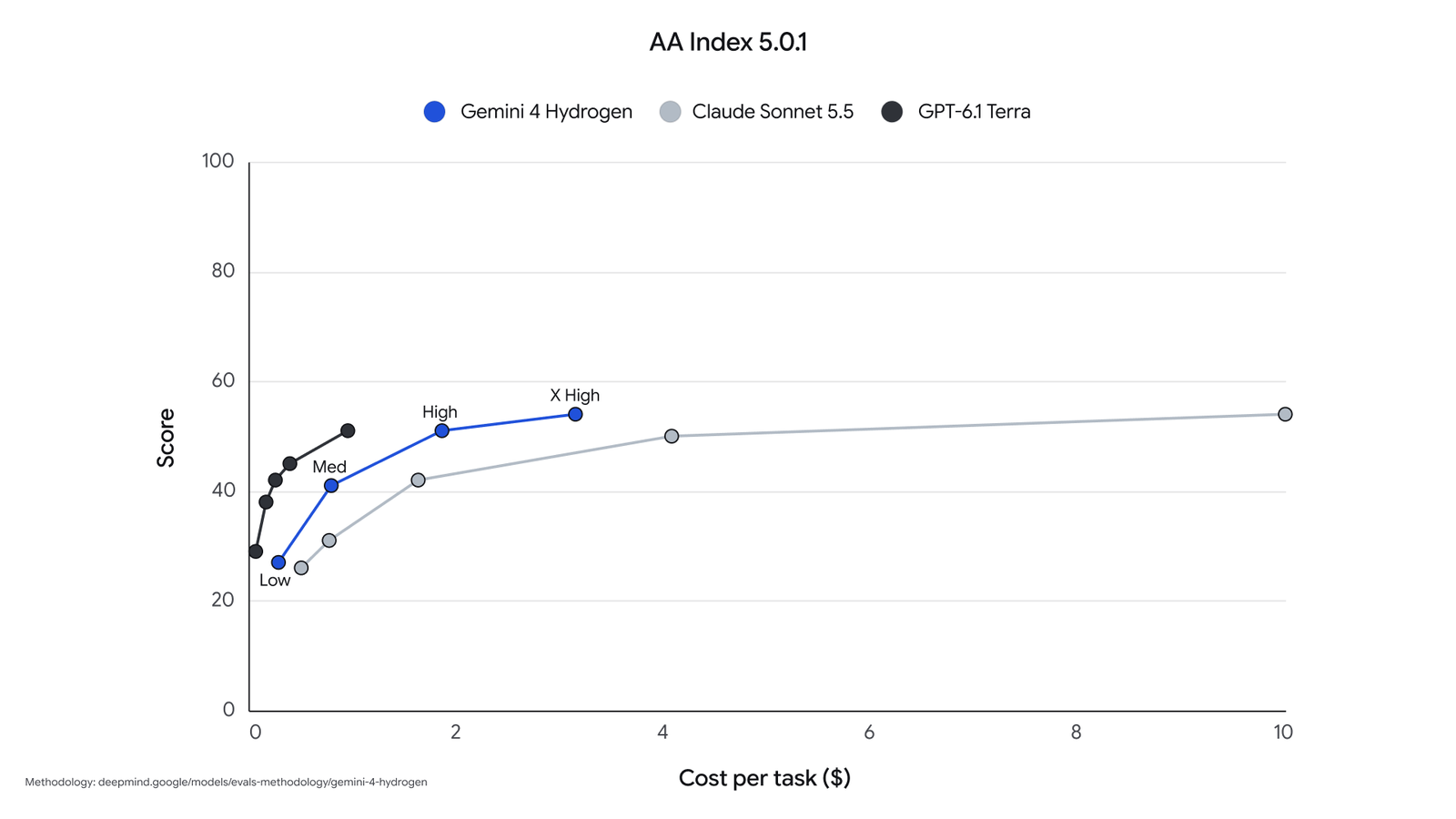
Chart from Google's launch post, using Artificial Analysis's index.
Google's cost chart is just as candid. At a similar score Hydrogen is cheaper per task than Sonnet 5.5, and GPT-6.1 Terra is cheaper than Hydrogen. Google drew that line itself.
Carbon plans, Hydrogen runs
Alongside the model, Google added Orchestrator to Antigravity, its agentic coding tool. It is one entry in the model menu, and its whole idea is to stop using a single model for the entire job.
Carbon starts read-only. It explores the dependencies, settles what is ambiguous and writes a plan that includes the conditions for re-planning. Hydrogen then takes the keyboard for the edits, the package updates and the test runs. When Hydrogen gets stuck it hands the task back. Carbon inspects the state, repairs the plan, and Hydrogen resumes. The Antigravity team calls it "a dynamic, bidirectional approach."
Google's result: on Terminal-Bench, Orchestrator reached what Google calls near-Carbon task success while using 24% less quota than Carbon alone and finishing 19% faster on average. Treat it as a vendor figure. Google gives no success rate for either side, and its two posts disagree on the benchmark version, 4.0 in one and 4.1 in the other.
The design matters more than the number. The expensive model reads and decides. The cheap model types. A second-place terminal score costs you less when a stronger model wrote the plan and catches the failures.
What's next
- Test it where a wrong answer is expensive. Count how often it admits it does not know.
- Keep the terminal on the stronger model for now. Let Hydrogen type from a plan rather than write the plan.
- Price the alternative this month. Carbon's launch price doubles on 1 December, so every step you move is worth more.
Route steps, not agents.

Founder of nativefirst.ai. Runs everything on agents and writes down what works.