Gemini 4 Carbon Costs $2 per Million Tokens. It doubles on 1 December.
Three weeks of frontier capability at mid-tier prices.

Google put its best Gemini on general release yesterday and gave it a price that expires. Gemini 4 Carbon costs $2 per million input tokens and $10 per million output. On 1 December both figures double, to $4 and $20.
That is not a discount in the usual sense. It is a stated list price with a date on it, published by the vendor in advance, and it gives anyone reading this about three weeks to use a frontier model at a mid-tier price.

Willison
"This is Google's best ever Gemini, priced at $2/million input and $10/million output at launch (that's GPT-6.1 Sol / Claude Sonnet 5.5 prices) but scheduled to double in price to $4/$20 on December 1st (same as Opus 5.5)."
Read the two comparisons in that sentence together, because they are the whole story. Today Carbon is priced like the tier below the frontier. In December it is priced like Opus 5.5. The model does not change. Only the invoice does.
Which makes the next three weeks a scheduling problem, not a pricing one.
Google's own caveat is the important one
Carbon opened to all paying developers through the Gemini API on 10 November, with AI Ultra subscribers getting it in the Gemini app, AI Mode in Search and Antigravity. The same day Antigravity put /swarm into preview across its app and CLI, where Carbon takes the coordinator, architecture, security-auditing and verification roles while, in Google's words, "lighter, faster models handle the parallel file edits and routine implementation tasks."
Read the sentence Google uses to describe its own model. Carbon is "built to explore thoroughly, reason deeply, and run extended verification loops using more tokens." More tokens is the design, not a side effect, and Google still points most software engineering and knowledge work at Argon. Google adds its own warning about /swarm: "parallel multi-agent systems consume quota much faster than a standard chat."
So the same posted price buys a more expensive job. A cheaper token price is not necessarily a cheaper finished job.
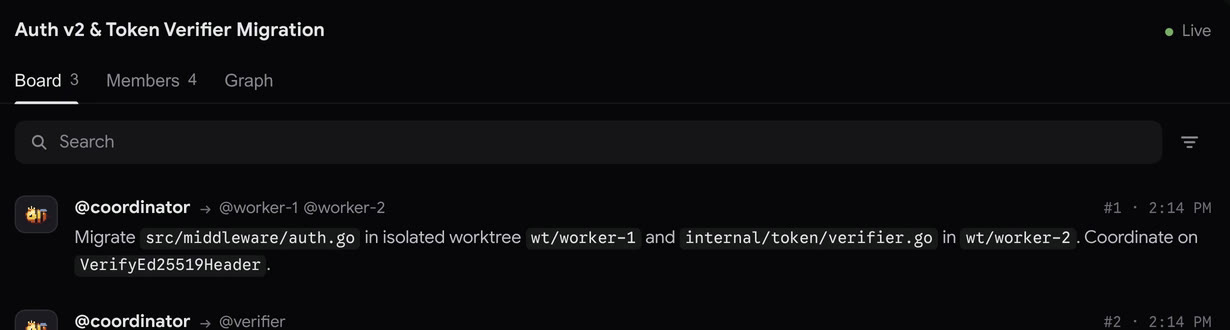
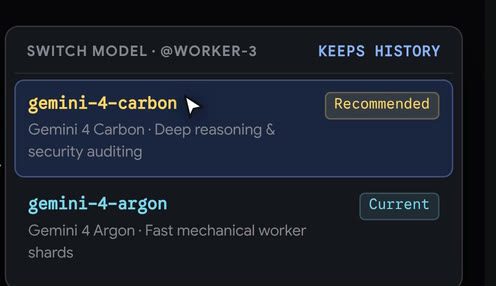
Google's own split, in its own product. Frames from Antigravity's launch post (1).
Day-one scores point the same way and should be read the same way. Cursor put Carbon at the top of CursorBench at 60.4% at high effort. Perplexity scored it 0.857 on their WANDR benchmark at $5.86 per task, and Aravind Srinivas called it 2.5 times cheaper than Fable 5.2 with similar capability on agentic research. Both are vendors shipping Carbon in their own products the same week. Every had seven people use it first: two would definitely reach for it, four sometimes, one no. That spread is a more honest day-one verdict than any single number.
What a 20-day price window is good for
The temptation with a cheap frontier model is to re-point your production traffic at it. That is the one thing not to do in a window, because the window closes and you will have rebuilt your routing around a price that no longer exists.
The work that fits a deadline is work that is bounded, batchable and finishes.
The habit this should build
Most teams cannot answer a simple question when a window like this opens: what does one finished job cost us today? They know the token price, because the vendor publishes it, and they have no idea of the job price, because nobody measures it. It is the same trap as a model that costs $1 or $100 per million tokens depending on the setting, and the same question as which task goes where once two models cost the same.
That gap is why a price change gets treated as news rather than as a decision. Perplexity could answer it immediately, in dollars per task, which is why they could say something concrete on day one while everyone else was comparing per-token figures.
So use the next three weeks for something better than cheap tokens. Pick your three most common agent jobs, run each one on Carbon and on whatever you use today, and record the finished cost and the outcome for both. On 1 December the price doubles and you will have a real table instead of a vendor's chart, which is worth more than the money you save.
Measure jobs, not tokens.

Founder of nativefirst.ai. Runs everything on agents and writes down what works.

 Fable 5.1