Gemini Decision 1 Scores 1,000 Questions in One Pass. Four agent steps should move.
Routing, tool selection, policy checks and grading are multiple choice. Stop paying a generating model to answer them.
On Wednesday Google DeepMind shipped a Gemini model that never writes a word. The Gemini Decisions API runs Gemini Decision 1, model name gemini-decision-1. You hand it one input and a list of questions with fixed answers. It hands back a probability for every option and a confidence from 0 to 1. Nothing is generated.
The launch post, written by Min Choi, a product manager at Google DeepMind, and Felix Yu, a principal scientist there, names the jobs it is for: tool selection, policy checks, model routing and context grading. Those are four steps inside almost every agent loop. Most teams run all four on a generating model and parse the answer back into an enum.
That is the Monday question. Which of your agent's calls are really multiple choice?
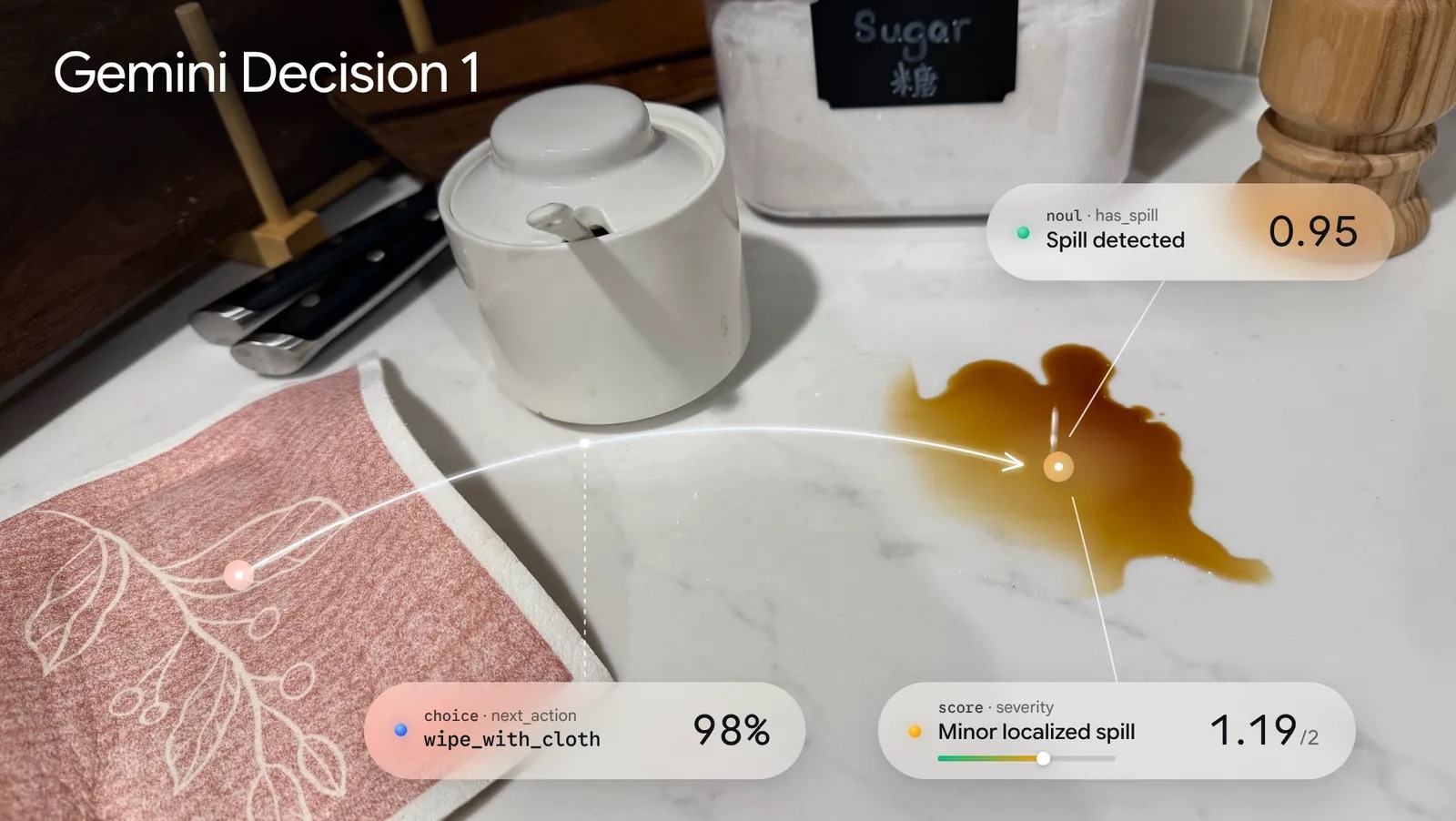
Google's launch image from Gemini Decisions API: Fast, calibrated multimodal decisions, 11 November 2026. The spill is Google's demo, not a customer.
What it actually does
Three question types, the same three the category settled on in September. A noul is a yes or no and returns the probability the condition holds. A choice picks from 2 to 255 options you write and returns a probability for each. A score grades against an ordered rubric starting at 0 and returns a continuous value plus the probability on each level.
The limits are generous. One input of up to 256K tokens, mixing text, images, audio, video and PDFs. Up to 1,000 independent questions against it in one request. Google puts end-to-end latency at 150 to 250 ms, with median model compute of 50 to 100 ms, and says latency stays nearly flat from 1 to 100 questions on inputs up to 16K tokens.
The price is $0.10 per million input tokens and nothing for output. The billing detail matters more than the rate: the shared input is billed once per request, however many questions you ask, and each question adds only its own instruction and criteria tokens. Twenty policy checks against one support ticket cost one ticket plus the words of twenty questions.
Google is the fifth to ship this
If this sounds familiar, it should. Jev, from TypeSafe, launched the category in September with the same three answer types, and we covered why the missing text box is the point. Matthias Bastian at The Decoder framed Google's launch as joining a wave, and the wave is real. OpenAI has a Decisions API on gpt-6-luna. Cloudflare released Clef on Workers AI on 1 October and described it in its own changelog as being in the same family as Jev. Microsoft followed with Microsoft-Decision-1.
Five vendors shipping the same primitive in about two months is not a feature trend. It is a new layer in the stack, and it means the decision call is now something you can buy from whoever already holds your API key.
The four steps to move
Google says its own teams already run on it. Gemini Notebook uses it to route each query to a model tier and thinking level, which Google says serves everyday queries with up to 40% lower latency. CC from Google Labs uses it to pick an emoji reaction from more than 200 options. Google Search uses it as a safety layer for MCP tools. Those map straight onto the steps in an agent loop.
1. Routing. One choice question: which model tier, which thinking level, or which sub-agent. This is what Gemini Notebook does, and it is the safest first move. A wrong route costs a slower or pricier answer, not a wrong one, and the latency win shows up immediately.
2. Tool selection. One choice over your tool names, up to 255 of them. The decision model picks the tool. It cannot write the arguments, so the generating model still fills those in. You have split one call into a cheap pick and a smaller write.
3. Policy checks. This is where the shared-input billing pays. Send the agent's proposed action once and ask every rule as its own yes or no: does this touch personal data, does it move money, is it outside the user's request. Google runs its MCP safety layer in Search this way. Every answer carries a confidence, so anything ambiguous goes to a human instead of through.
4. Grading. A score question against a rubric you write as situations, not adjectives. Grade the retrieved context before the agent uses it, or grade the output before it ships. This is the step most teams skip because a second generating call felt too slow. At 150 to 250 ms it no longer does.
Read Google's own table before you pick Google
The launch post includes a benchmark table, and it is more honest than most. Gemini Decision 1 leads seven of its nine accuracy rows and has the lowest calibration error. But it is not a clean sweep.
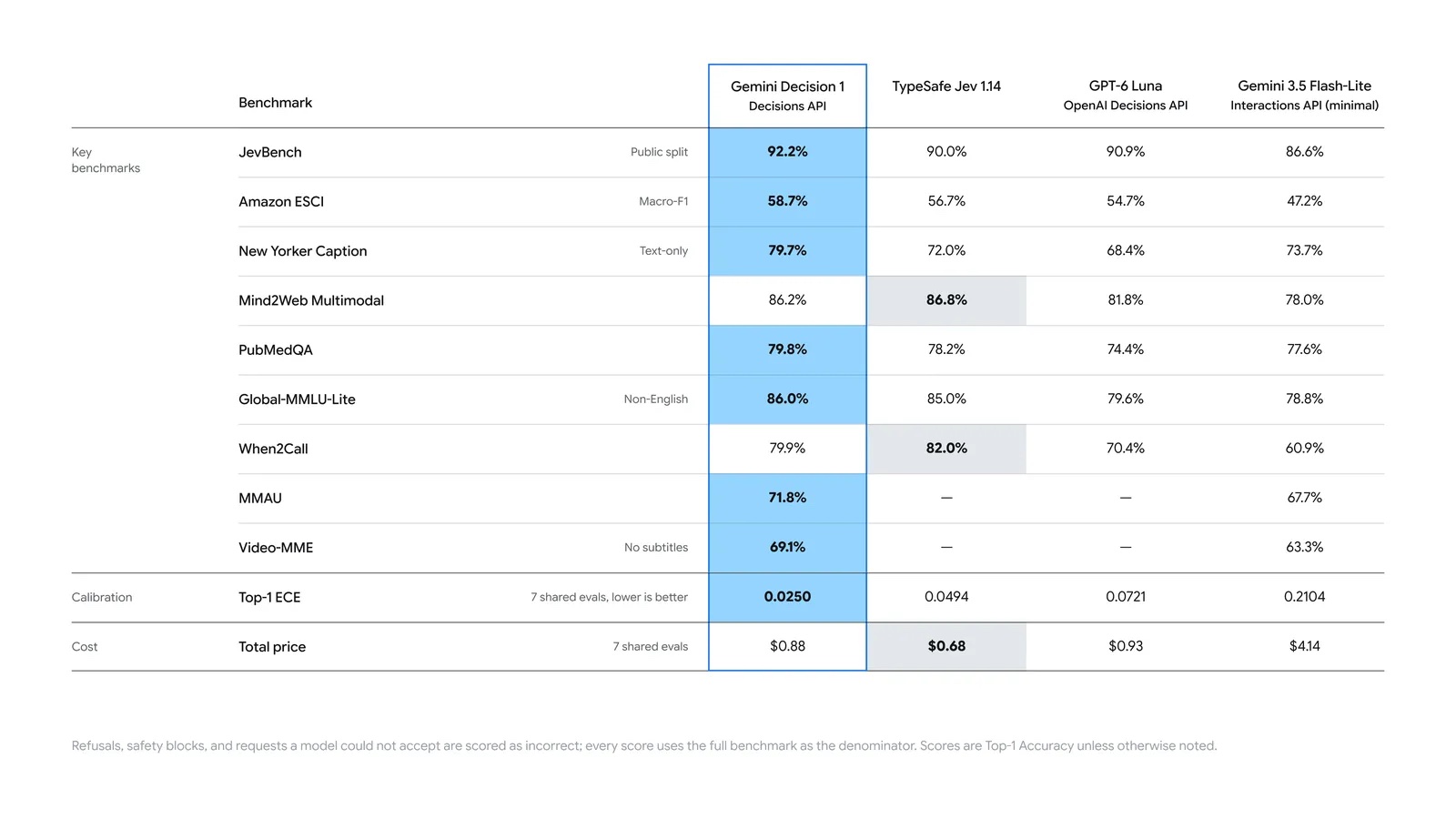
Google's own comparison, from the launch post, 11 November 2026. Vendor-run, so read it as a claim.
On the seven shared evals Google priced, Jev came out cheaper: $0.68 in total against $0.88 for Gemini Decision 1, with OpenAI's GPT-6 Luna at $0.93. And on When2Call, the benchmark for deciding whether a tool call is needed at all, Jev beat it on 11 November, 82.0% to 79.9%. That is step 2 in the figure. The rival is better at the exact job you were about to move first.
The bigger gap is the one Google wanted you to see. Against Gemini 3.5 Flash-Lite answering the same questions by generating, Google says its decision model is nearly five times cheaper on the shared suite. Between the decision vendors the spread is cents. Between a decision call and a generating call it is the whole budget.
What's next
- Find every model call you parse into a fixed value. A label, a tool name, a score.
- Move the router first. Log confidence on every answer and send anything low to the generating model you already have.
- Keep the request shape behind your own interface. One input, a list of questions. Vendors change; the shape does not.
Stop generating enums.

Founder of nativefirst.ai. Runs everything on agents and writes down what works.