Anthropic Put Claude Managed Agents Behind Your Firewall. The transcripts stay with you.
The security question moves from whether a vendor may hold your agent's data to whether you can run the harness yourself.

On Thursday 12 November Anthropic put a new version of Claude Managed Agents into private beta: one you run yourself. Managed Agents is Anthropic's set of APIs for long-running agents. It supplies the harness that calls the model, the sandboxes where the agent's code runs, the credential handling and the session history.
Until this week you had two choices. Anthropic ran all of it, or Anthropic ran the service and you hosted only the sandboxes. The new option moves the rest across. You operate the Managed Agents server, its database and the workers that run the agent's shell and file tools, in your own cloud account or your own data center. Model calls go where you point them: the Claude API, Amazon Bedrock, Google's Agent Platform, Microsoft Foundry, or your own gateway.
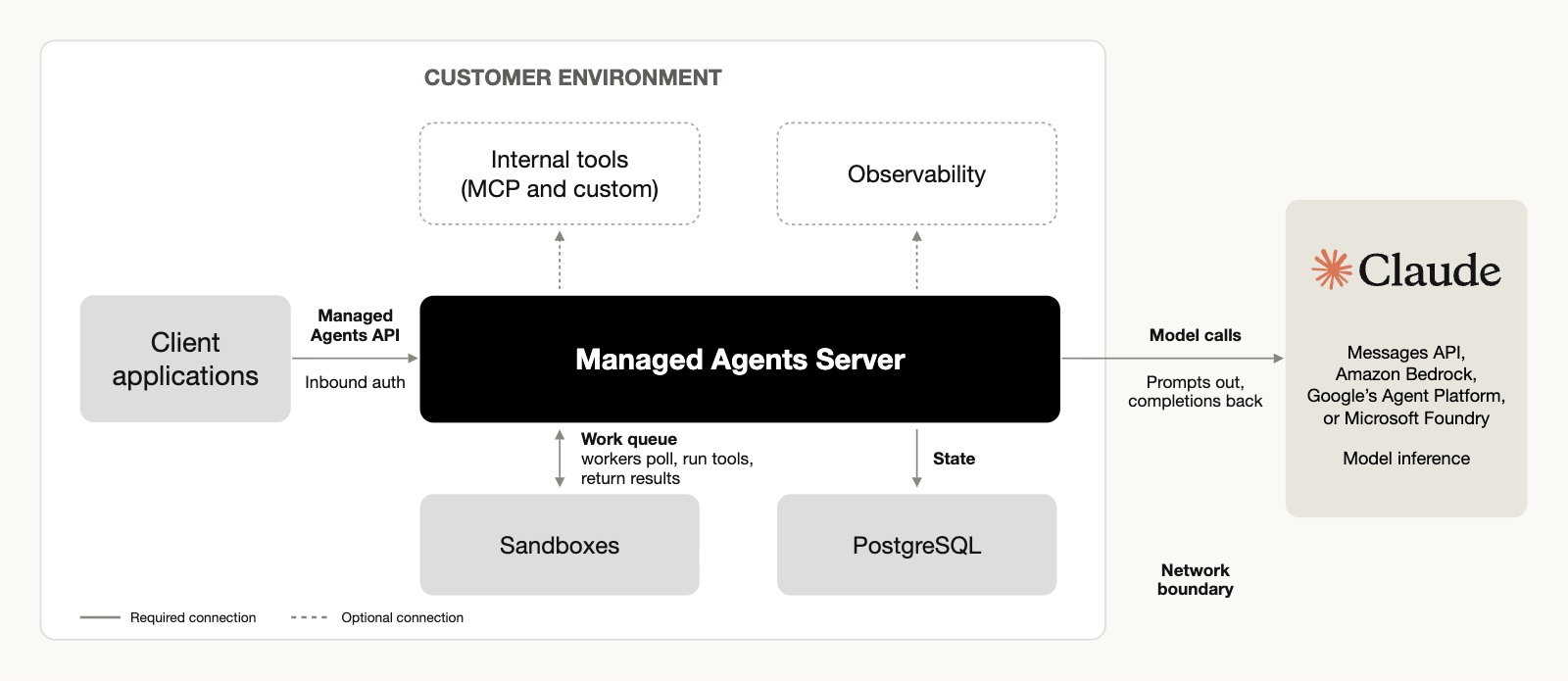
Diagram 1 from Anthropic's launch article, Operate Claude Managed Agents inside your security perimeter, 12 November 2026, rendered from Anthropic's own SVG.
The line that matters is in the retention docs
The launch article is short and calm. The sentence that changes a security review is in the documentation. Anthropic's own data and access page notes that its API retention policy lists Claude Managed Agents as not covered by zero data retention. The reason is simple. When Anthropic runs the service, it stores your session transcripts until you delete them.
Self-hosted, you store them. Agents, sessions and every step of session history live in your PostgreSQL. The model calls still go out, and if your organization has a ZDR arrangement with Anthropic, it covers those calls the same way it covers any Messages API call. The full record of what the agent did, which tools it called and what came back, never sits on a vendor's disk.
So the question your security team asks moves. It used to be: may we send this data to a vendor's agent? For many teams the answer was no, and the project died there. Now the question is: can we operate this harness? That is a better question to be stuck on, because it has an engineering answer. It is also a harder one than it sounds.
What you now own
Anthropic's self-hosted overview lists the parts. A server that serves the API, runs the agent loop and stores everything, and that never runs the agent's shell or file tools itself. A PostgreSQL 16 or later database. Workers that poll the server for work and run the tools in your sandboxes. A web console where people sign in through your identity provider. You install each release yourself.
Three details in those docs are the ones a team trips on.
- The database is optional, and that is a trap. Without one the server keeps everything in memory, and a restart erases it. Set up Postgres before the first real session, not after the first lost one.
- The shell is real. The agent's bash tool runs with the worker's permissions and network access, and the worker does not isolate it. Isolation comes from whatever you run the worker in. Anthropic's Docker Compose stack and Helm chart give each session its own container or pod. A worker you start by hand on a shared box gets none of that.
- One deployment per trust level. Environments inside one deployment do not keep trust levels apart, and the server API key reaches every environment. Trusted and untrusted code, or workers that touch systems only some people may use, need separate deployments with separate databases and keys.
The jobs the hosted security model gives to Anthropic, securing the server, hosting memory stores, spotting unusual usage, become yours. And some hosted features do not exist on your server yet: scheduled deployments, dreams, webhooks, the Files API, OAuth-refreshed MCP credentials and the prebuilt document skills. The differences page lists each one with a workaround. Nothing is copied over from the hosted service either, session history included. Read that page before anyone promises a migration date.
The pattern worth copying, even if you never install it
The launch article names four design principles that hold however you host. The brain is split from the hands: the harness calls Claude, and a separate sandbox, started only when a tool needs it, runs the code. Credentials stay out of the sandbox. Network access is limited to a list of allowed hosts. Every session leaves a full record that exports over OpenTelemetry.
The second one is the idea to steal. In August we compared Anthropic's sandbox that is destroyed after every session with Grok Bot's machine that keeps every login. Self-hosting shows the same design one level down, where you can inspect it. The day after this launch Anthropic published the same pattern again, as one of the five parts of an always-on agent.
Look at how far the docs push it. Git tokens never reach the sandbox: Git traffic goes through your server, which adds the token. MCP calls get their credential from a proxy outside the sandbox. Environment-variable credentials are refused until you turn on an egress gateway that injects them. The server can sign a short-lived token for each agent call to an MCP server, which your gateway checks against keys you publish. Even the worker's own environment key, which can read events and post tool results in every session in its environment, is meant to stay out of the sandbox.
That is the move to copy into whatever harness you run today, Managed Agents or not. Make the sandbox a place with nothing worth stealing. Put the keys one hop outside it, on a path that only reaches hosts you listed. A prompt injection that takes over the agent then gets a shell with no secrets in it, on a network that only reaches the hosts you listed.
Two caveats from the same docs, because the allowlist is not the whole job. The server does not refuse force pushes, so an agent can overwrite any branch you allow. Protect those branches on the Git host. And the server log reports a push as ok even when your host refused it, so check the branch, not the log.
What to log, and what still leaves
The server writes its log to standard error and records no traces or metrics until you set the standard OpenTelemetry variables. Out of the box, the full record the launch promises goes nowhere. Wire it to your collector before the first real session, so the agent's steps sit next to the rest of your system logs. If you turn on the Prometheus metrics endpoint, note that it asks for no credential, so restrict who can reach it.
Then read the outbound list with the same care a reviewer will. Each model call carries the whole conversation so far, tool inputs and results included. That re-sent context is also where the bill is: Garry Tan's harness evals traced about 81% of the gap between two harnesses to what each one re-sends every turn. When the Claude API is the provider, calls also carry your session, agent and environment IDs in headers, and no setting turns those off. Anthropic says it has no remote access to the server or its log, and the server connects to Anthropic only when the Claude API is the provider.
One setting deserves a decision on day one. With the Claude API as provider, server-side fallback is on by default. When a safety classifier declines a request, another Claude model, possibly a less capable one, can answer instead, and no event reports the switch. A read of the session shows the model's ID. If you need to know exactly which model did the work, set inference.model_fallback to false.
What's next
- Name the owner. Who on your side runs, patches and pages for the harness. That answer, not the vendor's, is the decision.
- Count your trust levels. That number is your number of deployments. Stand up Postgres and OpenTelemetry before the first real session.
- Write the allowlists. MCP hosts, Git hosts, push refs. Move every key one hop outside the sandbox.
Same API. Your pager.

Founder of nativefirst.ai. Runs everything on agents and writes down what works.