A Teardown of the Anthropic IPO.
Shares, votes, revenue, customers, compute and the risks it names itself.

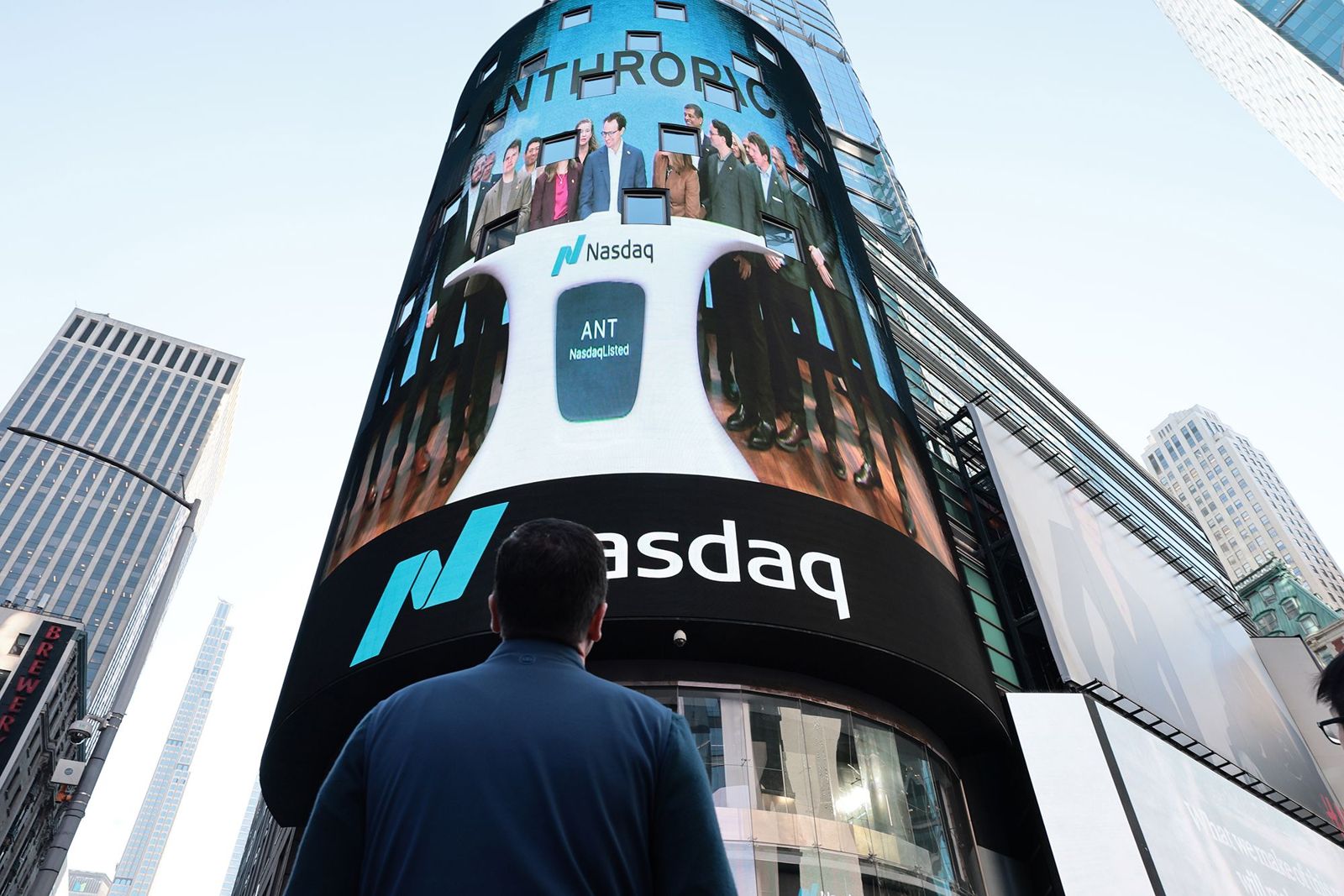
Anthropic priced its IPO on 18 November at $83 a share, above the $70 to $78 range, opened at $111.50 on 19 November, touched $115.10 and closed the day at $97.17, up 17.1% on the IPO price. The prospectus that set the terms is Amendment No. 3 to its Form S-1, filed on 17 November. This is a walk through that document, part by part, in its own figures.
Nothing here comes from the coverage. Every number below is read from the filing, and most of the launch articles are still quoting the half-year numbers from the first filing in October rather than the nine-month numbers in this one.
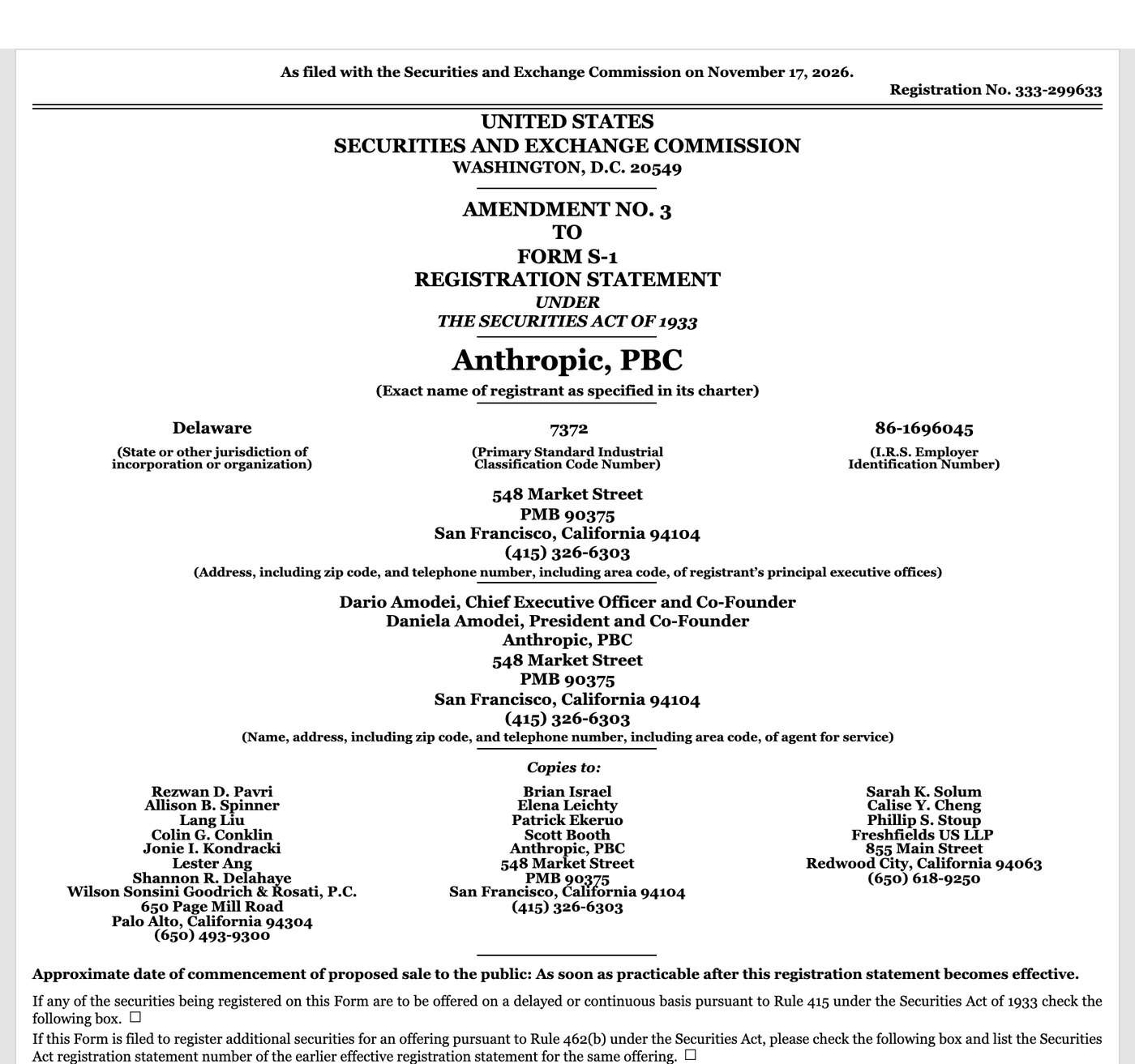
Screenshot by nativefirst of the filing on SEC EDGAR.
The verdict
The business is elite. The price is not a free lunch, and the bill underneath it is the real question.
Growth, margin and cash. All pointing up.
Revenue up 45 times in seven quarters. 85.5% margin on serving customers.
Demanding. Bounded by growth.
16.0x run-rate sales at $83.
Multiples use the filing's share count and the press price, so they are approximate until the final prospectus is read.
Four prices reported by CNN. The day's low was $92.72. Between the open and the close the stock gave back most of the pop, then held above the offering price.
Revenue grew 45 times in seven quarters, and compute got dearer in the last one
Compute fell from 251% of revenue to 48%, then rose to 58% in the quarter before the IPO.
Bottom row: compute and infrastructure as a percent of that quarter's revenue.
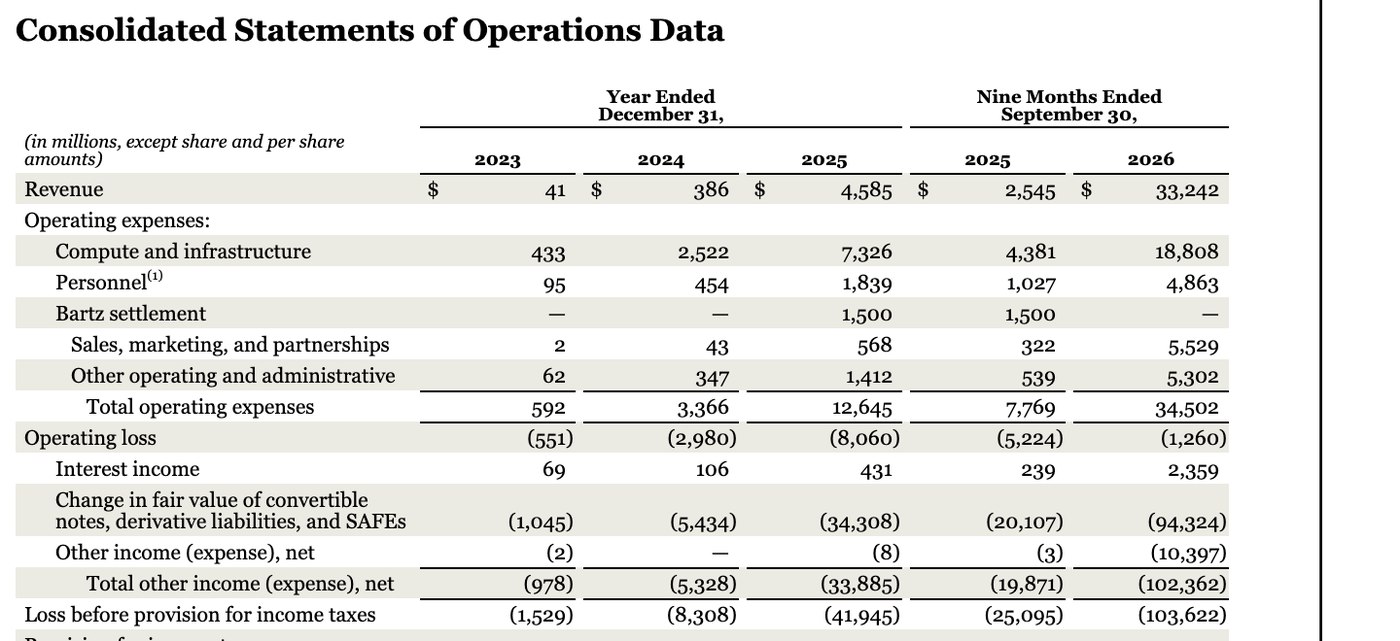
Q2 2026 was the first profitable quarter, with operating income of $1.0 billion. Q3 swung to a $0.6 billion operating loss. The filing blames $5.0 billion of compute bought on short-term commitments, which it says costs significantly more than compute under multi-year contracts, plus $2.0 billion of non-cash charitable charges. Adjusted operating income still rose, from $2.2 billion to $2.5 billion, but the adjusted margin fell from 19% to 15%. Growth is outrunning the cheap capacity. That is the margin story to watch.
Across the nine months, cost of revenue was $4.8 billion on $33.2 billion of revenue, an 85.5% margin from 29.4% a year earlier. That is our arithmetic on the filing's function table. R&D, mostly model-development compute, was $19.2 billion beside it.
The $104.0 billion loss is mostly a valuation mark
The business lost $1.3 billion. A rising valuation did the rest.
The filing says convertible notes, derivatives and SAFEs are marked to market, so a higher company valuation drives the expense up, and it falls away as the notes convert to stock. Cash tells the other half: operating cash flow was $6.6 billion positive while financing inflows were $110.7 billion. A chart that plots the full loss as one block, which is how it is circulating, shows a loss the business did not make in cash.
The adjusted figure is no cleaner. Adjusted operating income of $4.1 billion is the $1.3 billion operating loss plus $3.3 billion of stock-based pay and $2.1 billion of non-cash charitable contributions. Read it as management's view of the business, not an accounting standard.
What you are paying for
The same lens we used on the SpaceX IPO, applied to Anthropic.
| Anthropic | SpaceX | |
|---|---|---|
| Revenue growth | up 1,206% in nine months | up 34% in 2025 |
| Public float | 6.3% of shares | 4.2% |
| Raised | $84.6B net, filing midpoint | $75B |
| Loss | operating −$1.3B, net −$104.0B | GAAP −$4.9B |
Anthropic costs 30.8x trailing sales at the final price, against 95 to 113 for SpaceX, while revenue is growing many times faster. The comparison flatters Anthropic less than it looks: SpaceX's growth is slow and steady, and Anthropic's depends on one thing continuing, which is usage.
What has to be true
Reverse the price into the growth it demands.
| Case | Growth a year | 2031 revenue | Exit multiple | Per share | Return a year |
|---|---|---|---|---|---|
| Bear | 15% | $136B | 6x | $63 | −6% |
| Base | 30% | $252B | 8x | $154 | +13% |
| Bull | 50% | $515B | 10x | $394 | +37% |
These are our assumptions, not predictions, on the filing's 13.1 billion shares and the $83 press price. Even the bear case needs $136 billion of revenue, double today's run-rate. What the scenarios leave out is the commitments below.
The raise covers 1.2 years of what is due next year
$900.9 billion is owed. $13.8 billion is contracted.
Net proceeds at the midpoint cover 1.2 years of the $70.7 billion due in the next twelve months, and 19% of the $451.6 billion due before 2031. Remaining performance obligations count only non-cancelable arrangements, so they are not a forecast of all revenue. The gap is not a default risk by itself. It is the size of the bet that usage keeps growing, and the filing's own risk factors say so.
About 6.3% of the stock trades now
The first big unlock follows FY26 earnings, and the next is day 180.
Only the 6.3% sold in the offering trades freely. The filing's schedule releases up to 315 million employee shares on day one, then 1,700 million two trading days after FY26 earnings, which is 13% of shares outstanding. By Q1 2027 earnings, or day 180 if sooner, another 3,000 million are free. The last tranche arrives at 365 days. Unlocks tied to earnings dates mean the calendar moves with the results.
The co-founders hold 61.3% of the vote and 12.8% of the shares
Control and ownership are different things here.
One Class F share, held by a company the co-founders set up, carries 50.1% of the vote and no economic rights. The seven co-founders add about 1.6% each through Class A. The Long-Term Benefit Trust holds Class T and elects a board majority, which makes Anthropic a controlled company under Nasdaq rules. Class N has no vote and is 43.2% of the stock.

Amodei
“We will not bend to either business nor political pressure. Today puts the company in a stronger financial position, and in doing so, only strengthens our resolve to do the right thing.”
Founders rarely keep control after an IPO, according to a study of more than 18,000 venture-backed firms. This structure is built to be the exception.
Each co-founder also sells 3,378,378 shares in the offering, about $280 million each at the final price, and keeps a stake worth about $19.8 billion. Both are our arithmetic.

Amodei
“A big part of why we’re going public is to have more people invested in building AI well.”
The people and the numbers going around
About 5,300 employees, so the averages are large.
The filing counts approximately 5,300 employees, up from about 940 at the end of 2024, and trailing revenue per employee of over $6.6 million, from $1.4 million a year earlier. Posts on X put the average employee at $44 million, employee equity at $232 billion and option gains at $119 billion. We checked what the filing lets us check.
“Seven co-founders at about $20 billion each.”
“Average employee worth about $44 million.”
“Employee option gains of $119 billion.”
“598 employees over $100 million, 2,800 over $1 million.”
Who the revenue depends on
A few big channels carry most of it.
Use of proceeds is general corporate purposes, and directors' affiliates indicated up to $303 million of purchases in the offering.
The risks they name themselves
Top five of thirteen, in the filing's order. Competition is seventh.
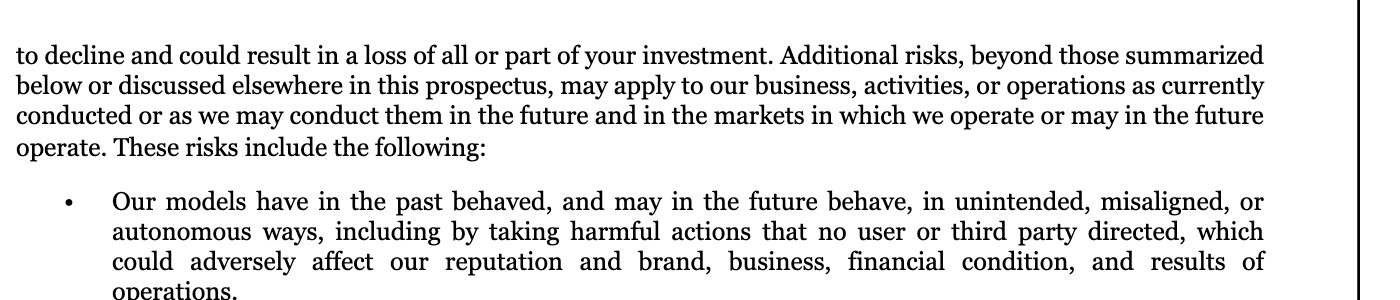
Screenshot by nativefirst of the filing on SEC EDGAR.
What is not in the filing

The final share count and price

Per-model economics

Training compute and roadmap
What would change our read
Adjusted operating margin
Compute share of revenue
Contracted against committed
Top five customers
Cloud marketplace share
What's next
Three dates that test the call.
- Final prospectusDate TBA424B4Final share count replaces our estimates.
- First big unlockAfter FY261,700M shares · 13%Two trading days after earnings.
- Second unlock18 May 2027 (est.)3,000M more sharesDay 180, or Q1 2027 earnings if sooner.
Earnings dates are not announced. Unlock timing follows the filing's schedule and is an estimate.

Founder of nativefirst.ai. Runs everything on agents and writes down what works.