GPT-6.2 Astra and Sol: First Reactions
Epoch has it level with Fable 5.2. Testers say it regresses to the mean.

Updated 17 November 2026, 22:10 UTC. Launch day, roughly four hours after the models went live.
OpenAI shipped two models on 17 November: GPT-6.2 Astra and GPT-6.2 Sol. The system card went up the same day, and the launch post had 2.7 million views within two hours.

GPT-6.2 Astra and Sol are now available. Super efficient and built to perform where it counts, the real world.
Sam Altman said nothing. His last post was two weeks earlier.
The first day produced an unusually clean split. The benchmark organisations that tested it early say it is at the frontier. The people who used it say it is strange. Both are right, and the gap between them is the story.
| Who | What they are | Verdict |
|---|---|---|
| Epoch AI | Tracks AI progress | Frontier, level with Fable 5.2 (post) |
| Artificial Analysis | Independent benchmarks | New robotics leader (post) |
| Ethan Mollick | Wharton professor, early tester | Uneven, weird, hard to steer (post) |
| Theo Browne | T3 Chat, early tester | Regresses to the mean (post) |
| Dan Shipper | Every, weeks of testing | Disappointing against Fable 5.2 (post) |
| OpenAI | Its own system card | Omits blockers twice as often (our post) |
What OpenAI actually shipped
Two models, the same context window, a 20% price cut on the big one.
| GPT-6.2 Astra | GPT-6.2 Sol | |
|---|---|---|
| OpenAI's description | "Our most capable model for your hardest projects, from start to finish" | "Our go-to model for everyday work, from coding to powering agents at scale" |
| Price per million tokens | $8.00 in, $40.00 out | $2.00 in, $10.00 out |
| Against the model it replaces | GPT-6 Astra was $10.00 and $50.00, so this is 20% below what GPT-6 Astra cost | Unchanged from GPT-6.1 Sol |
| Context window | 1,050,000 tokens, with 128,000 maximum output, on both | |
| Knowledge cutoff | 18 May 2026 | 1 June 2026 |
| Where | The API, ChatGPT and Codex. Both take text and images and return text, and both refuse a request that sets reasoning effort to none | |
That price cut is what "super efficient" points at: Astra does the same work as GPT-6 Astra for four fifths of the money, and Sol stays where GPT-6.1 Sol was.
Build first If you are on GPT-6 Astra, the same prompts now cost 20% less. That is the one change you get for free.
What Sol is for
The cheap one is the interesting one, and nobody reviewed it.
Sol is a quarter of Astra's price and one point behind it on the only independent benchmark published on day one. OpenAI pitches it at everyday work and agents at scale, which is most production traffic.
No early tester published anything about Sol specifically. Mollick, Browne and Shipper all tested Astra. Every verdict below is about the expensive model, and the cheap one that most teams would actually deploy went unreviewed on launch day. That is worth knowing before you read them.
What the benchmarks found
Two independent groups, both testing before launch, both positive.
Epoch AI, the research group that tracks AI progress, put Astra at 174 on its Capabilities Index, level with Claude Fable 5.2 and above the trend line that reasoning models followed before Astra existed. They are careful about it: the testing used only their own benchmarks, and they say the index moves as more results arrive.

GPT-6.2 Astra scores 174 on the Epoch Capabilities Index, on par with Fable 5.2 and joining it above what the pre-Astra trend for reasoning models would have predicted.
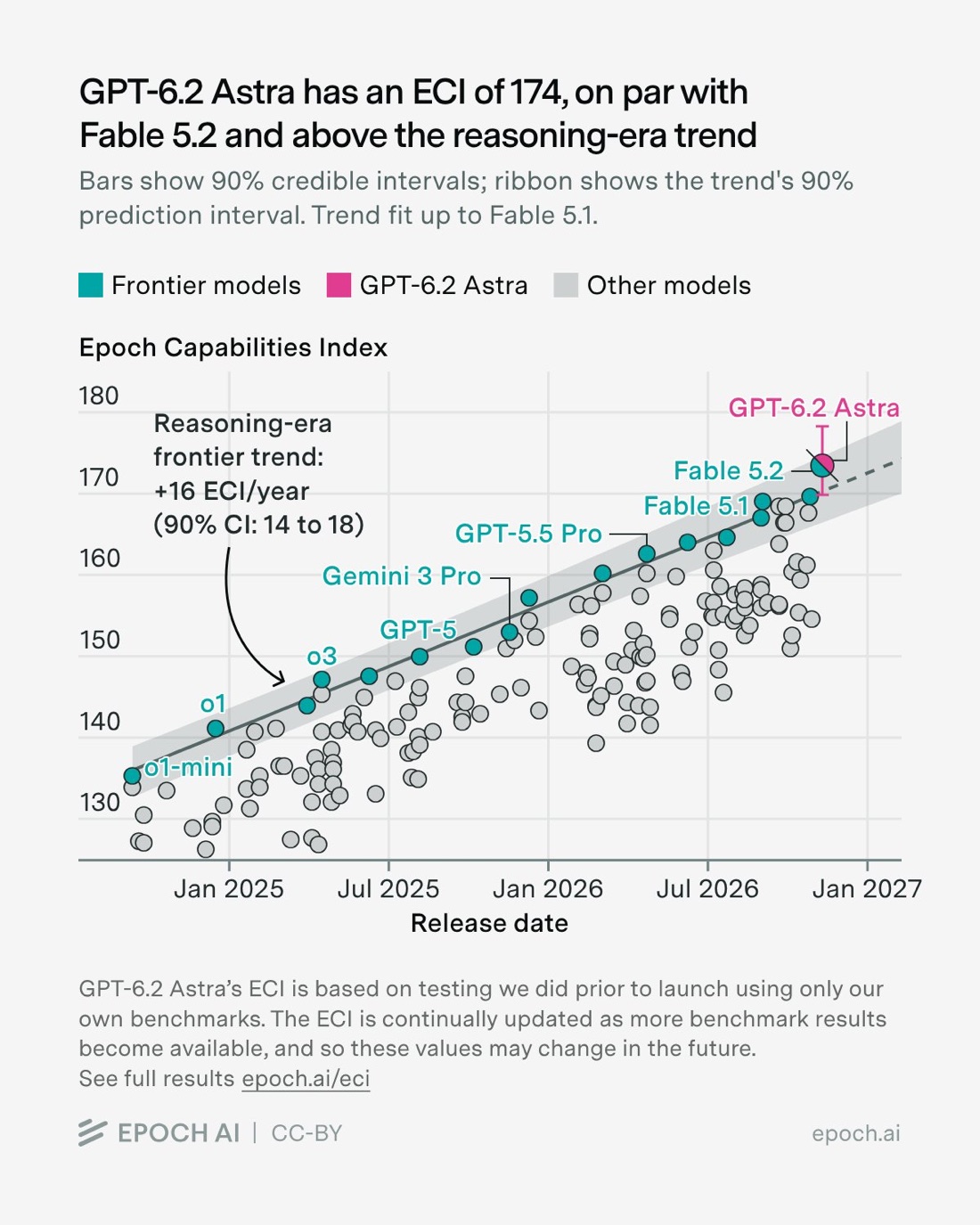
Chart by Epoch AI, published 17 November 2026, used under CC BY.
Artificial Analysis ran it on a real robot arm through Codex and made it the new leader on their robotics benchmark. It passed six of eight physical tasks, half-finished pouring a liquid, and could not measure a box.
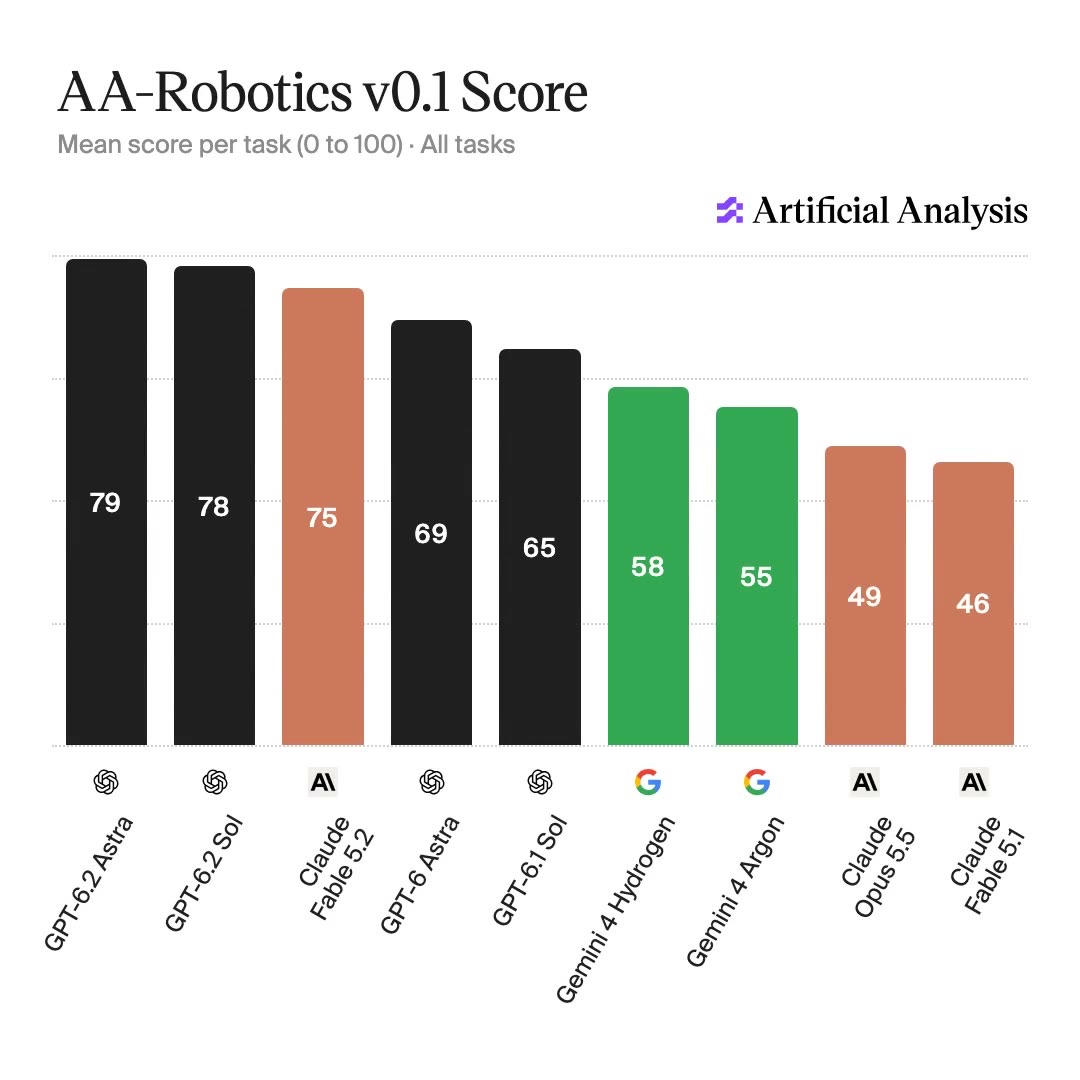
Chart from Artificial Analysis, 17 November 2026, from the video of their robot-arm run.
The same group also tested OpenAI's specialised legal configuration, Astra for Law 6.2, on their implementation of Harvey's LAB benchmark: 120 private tasks across 24 practice areas, scored on a measure that penalises hallucination. It leads at 20.8%, against 15.0% for plain Astra at maximum effort. Those are low numbers in absolute terms, which is the point of a hallucination-gated score on real legal work. We wrote about the first version of that configuration in Astra for Law indexing US case law.
Build first Note who tested before launch and with whose benchmarks. Both of these are pre-release results from the organisation's own test set.
What the testers found
Three early testers, independently, describe the same personality problem.
Ethan Mollick, the Wharton professor who writes about using AI at work, had access before launch.

I've been using GPT-6.2 Astra prior to launch & I found it very uneven & weird. On one hand, it was harder to steer & work with than other models. On the other, when given an ambitious project it could deliver well.
Theo Browne, who runs T3 Chat and tests models publicly, found something sharper. He and another tester each asked Astra 6.2, separately and in their own words, to design a new level for a game they loved. One picked Majora's Mask, the other Outer Wilds.
Both got a water level. Both got a music theme. Both were built around bells. Both were called Bellwether.

This model regresses to the mean like nothing I've ever seen. Go ask it to make a new level for a game you love, lmk if it chooses "bellwether" as the name.
Dan Shipper, whose team at Every has been testing both models for weeks, published the bluntest verdict of the day. He broke it into three parts.
On writing, a step back from Astra 6: trained to be so concise that its answers are hard to follow, and short where length was warranted. On coding, similar to Astra 6 on their benchmarks, but it stopped too early on real end-to-end builds. On design, good instincts and a house style it struggles to vary.

We've been testing them for the last few weeks and, unfortunately, these models aren't great. Overall a disappointing release compared to Fable 5.2.
Read those three together and they are not three opinions. They are one observation from three angles: the model has collapsed toward an average. A house style in design, a single name for two different games, answers compressed to the point of obscurity, and a tendency to stop early rather than push on.
Build first Test variety, not just quality. Ask for the same artefact twice, in two sessions, and see how far apart the answers land.
Why both can be true
We have numbers for capability and nothing for taste.
Mollick drew the conclusion himself a few minutes later, and it is the most useful sentence of the day.
We lack good measures of personality or perseverance or creativity or writing clarity or taste. But these things matter.
A capabilities index measures whether the model can do the task. It does not measure whether two runs produce two different answers, whether the prose is readable, or whether the thing gives up at 80%. Those are the properties the testers hit in a day, and no public leaderboard reports them.
What is already known to break
OpenAI published this one itself, on launch day.
The system card reports that Astra 6.2 omitted a known obstacle in about twice as many trials as GPT-6 Astra, and that the fix lives in the Codex developer prompt, which is not applied to direct API calls. If you call the API yourself, you do not get it. We covered the numbers and what to do about them in OpenAI's own tests on omitted blockers.
The variety test
Two fresh sessions, the same kind of prompt, then compare.
# Session 1, no system prompt, no history
Design a new level for [A GAME YOU KNOW WELL].
Give it a name, a setting, a core mechanic and a short description.

# Session 2, new chat, same model, same effort setting
Design a new level for [A DIFFERENT GAME YOU KNOW WELL].
Give it a name, a setting, a core mechanic and a short description.

# What you are looking for
Not quality. Overlap.
Same element (water, fire, bells)? Same name? Same shape of answer?
Two different games should not converge on one level.
We could not run this against the API ourselves from this machine, so the block above is for you rather than a result from us. Browne's version produced two water levels, both built around bells, both named Bellwether, from two different games.
Still to come
What is missing on day one, and what we will add when it lands.
Three things are not available yet, and they are the three that would settle the split in this post. There is no independent coding-agent result from a group that did not test pre-release. There is no public measure of the variety problem.
And there is nothing published on Sol from a hands-on tester, despite it being the model most teams would deploy. We will update this post as those arrive.
What's next
- Do not switch on the index score. The tie and the complaints are both true; only one shows in your week.
- Run the variety test above. Same prompt, two fresh sessions. Look for overlap, not quality.
- Add the Codex developer prompt to your own API calls. A raw call does not get it.
Measure taste yourself.

Founder of nativefirst.ai. Runs everything on agents and writes down what works.