OpenAI Built ChatGPT Wallet for Merchants, Not Shoppers. Each card number works once.
The checkout code needs no changes. The firewall and the fraud engine do.

On Friday OpenAI launched ChatGPT Wallet, a way for its dots agents to pay for things on your behalf. It was built with American Express, Mastercard and Visa, and it starts small: ChatGPT Pro subscribers in the US, aged 18 and over, with an eligible US-issued card.
Read the consumer pitch and it sounds like a checkout button. Read the rest of what OpenAI published the same day and it is something else. Chaya Nayak, who leads monetization and payments product at OpenAI, told CNBC that the people this launch is really addressed to are the card networks and the merchants. Not the shopper.
She meant it. The announcement ships with a merchant playbook, a new HTTP header, a list of fraud vendors and a list of CDNs. That is a spec. The shopper is the demo.
What the shopper sees
You add a card once. Your dot finds the thing. Before anything is charged you see the items, the total and the card, and you approve with a security check like Face ID or a fingerprint. Then the agent finishes checkout on the merchant's own website.
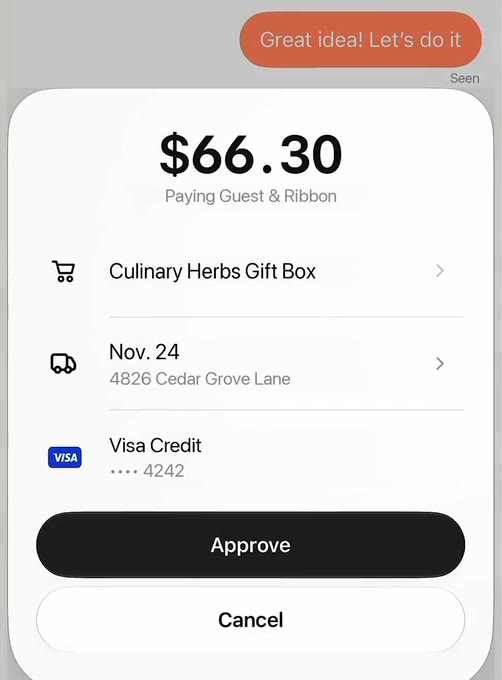
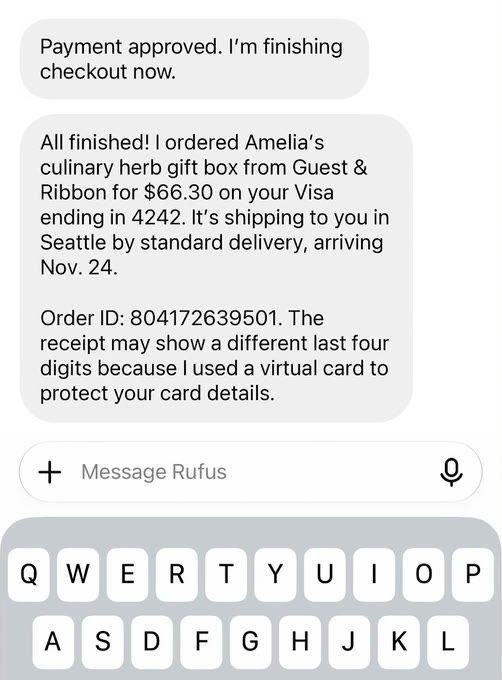
Stills from OpenAI's launch video on Introducing ChatGPT Wallet, 13 November 2026. The merchant and the purchase are OpenAI's demo.
That receipt line is the product. After you approve, the card network issues a payment token: a stand-in card number, security code and expiry date. The charge lands on your real card, but neither the agent nor the business ever holds it. OpenAI's own merchant FAQ spells out the rule. The customer consented to one transaction, so the merchant must not reuse or save that credential for a separate purchase.
A card number that works once is a very different object to hand an agent than a card number that works forever. A leaked prompt, a confused tool call or a malicious page can at worst spend the one purchase you already approved. That is why the networks signed up, and it is why Luke Gebb, who runs global innovation at American Express, framed the launch to CNBC as a contained environment to watch before rolling further.
The homework is on the merchant's side
OpenAI's accept-payments guide says the wallet works with existing checkout pages and payment forms, with no wallet-specific integration. That is true and slightly misleading. Nothing breaks in your checkout code. Things break in front of it.
Your firewall decides first. The dot shops through a cloud browser, and a cloud browser looks like every bot your CDN was tuned to stop. OpenAI signs those requests with Web Bot Auth. Akamai, Cloudflare, HUMAN and Vercel verify the signature automatically, according to OpenAI's agent access page. Anyone else has to configure it by hand.
Your risk engine decides second. Fraud scoring leans on the buyer's IP address and browser fingerprint, and a cloud browser has neither of the user's. So OpenAI is rolling out a Forwarded header that relays the user's signals: an IP prefix, the network's AS number, country, locale, time zone and user agent. OpenAI says it is working with Forter, Riskified, Sardine and Signifyd on fraud, and Adyen, Checkout.com and Stripe on payments, so their systems recognise legitimate agent purchases. If your risk stack is in-house, nobody is doing that for you.
Your checkout decides last. Card-on-file habits die here. The token is for one purchase. Subscriptions are allowed if your checkout already supports recurring billing and you collect consent for the recurring charges, but a token from one order is not a credential for the next.
Why OpenAI is not charging for it
CNBC reports OpenAI is taking no cut of transactions to start. Compare that with OpenCommerce, which charges agent developers 1% of every completed order to drive stores that never signed up. OpenAI is doing the opposite: paying for adoption with a free rail, and asking merchants to open the door rather than routing around it.
It is also a second attempt. CNBC notes that Instant Checkout, the earlier in-chat buying feature, was pivoted away from. This time the purchase happens on the merchant's own site, and OpenAI's page says the business keeps the customer relationship, pricing, fulfilment, returns and service.
The scale explains the patience. OpenAI's announcement puts ChatGPT at 1.2 billion people a week. CNBC puts paying users at nearly 100 million at the end of the third quarter. Wallet launches to one paid tier in one country. That is a pilot with a very large waiting room.
What's next
- Check your CDN's bot rules. Find out today whether verified ChatGPT browser traffic reaches your checkout or hits a default block.
- Ask your fraud provider about the Forwarded header. If it does not read it yet, you are scoring agent traffic blind.
- Confirm checkout stores no card for later. A one-time permission is the whole point of the spec.
Give agents receipts, not cards.

Founder of nativefirst.ai. Runs everything on agents and writes down what works.