Almost every number published about company AI spending in 2026 points the same way. Up.
Ramp's own data has the top 1% of firms spending roughly 600 times the median company. Token prices fell about 99% in three years and nobody's bill went down. The pattern has been consistent enough that most CEOs now treat a rising AI line as proof the programme is working.
600x
What the top 1% of AI spenders spend against the median company. Measured, a16z.
99%
Fall in token prices over three years. Almost nobody's bill fell with them.
Stage 1
Where the overwhelming majority of companies still are, per Notion's COO.
On October 23, Ramp's economist published the first serious counterexample. The companies furthest along the adoption curve have started spending less. And the company he named is not one that got scared and pulled back.
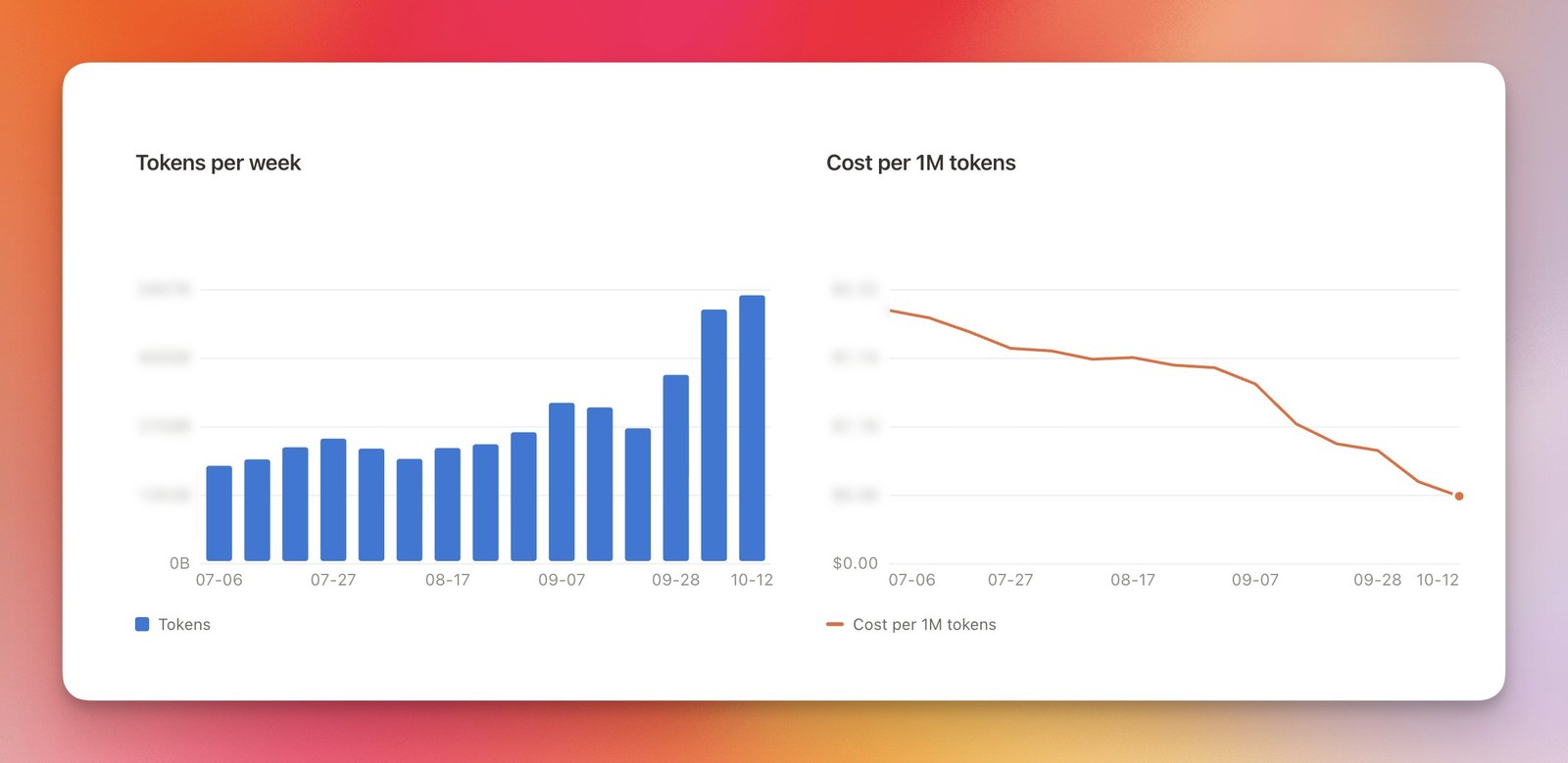
The chart behind "tokens go brrr, costs go ahhh", posted by Notion COO Akshay Kothari, 22 October 2026. This is the image Kharazian was reading when he said he could not see the scales.
Kharazian
"The most advanced AI adopters are now spending less on AI as they advance along the adoption curve. We can't see the scales on these charts but based on Ramp data among top 1% firms, it's possible Notion has engineered an outright decline in total AI spend."
Read the hedges, because they are load bearing. "We can't see the scales." "It's possible." This is Ramp's economist reading a chart Notion published, not Notion publishing its bill. Nobody has audited this and Notion has not confirmed a decline.
What makes it worth a post anyway is who replied, and what he called the thing.
Notion's COO named three stages, and most companies are in the first
Akshay Kothari runs operations at Notion. The day before Kharazian's post he had put up a chart of his own with four words on it: "tokens go brrr, costs go ahhh." When Kharazian read a decline into it, Kothari did not confirm the decline. He did something more useful. He named the path.

Kothari
"I think you're right about this happening at the most advanced (or earlier adopting) businesses. At the same time, the % of companies who have done the full arc of tokenmaxxing to token questioning to token economics is still very small."
Three stages, from an operator who has run his company through them. That is the part to steal.
Why a falling bill is the expensive outcome, not the cheap one
The instinct when a budget line falls is to assume someone cut it. That is stage zero behaviour and it looks identical on a chart to stage three.
It isn't the same thing. Tokenmaxxing is a real and necessary phase: you spend wastefully on purpose because you do not yet know which calls earn their keep. You cannot skip it. The companies that never enter it never learn anything, and their bill is low because nothing is happening.
Stage three costs something to reach. It means a team went through the pipeline and asked, call by call, what each one was actually for. The moves are unglamorous and they are the same moves every time:
Route by difficulty. Most production calls are not generation. They are a choice between three options, and they were being billed at frontier rates. Routing the easy ones down a tier is the single largest line item in most audits.
Gate before you generate. Put a cheap calibrated judgment in front of the expensive call so the expensive one only runs on what survives. That is the whole architectural argument for models that cost 238x less and cannot write a sentence.
Cache what repeats. Cached input on most frontier models bills at roughly a tenth of standard. Teams in stage one rarely know what fraction of their traffic is repeat context, because nobody has looked.
None of this is a cut. Output keeps climbing. The bill bends because the work got engineered, and Coinbase halving its AI bill is the same story told a quarter earlier.
What this does and does not let you say
Be careful with this one in a board meeting, because it is easy to overstate and the overstatement is checkable.
What is supported: Ramp's economist, looking at Ramp's own card data across top-1% AI spenders, believes the most advanced adopters have started spending less as they mature. Notion's COO, unprompted, described a three-stage arc ending in deliberate cost engineering, and said very few companies have completed it.
What is not supported: that Notion's AI bill fell by any specific amount, in any specific period. Kharazian said he could not see the scales. Notion has published no figure. Anyone who tells you Notion cut its AI spend by X% is inventing the X.
The useful version is not the number anyway. It is the shape. A rising AI bill is evidence of activity, not of maturity, and the two have been treated as the same signal for about two years.
The question to ask on Monday
Kothari's throwaway clause is the one worth keeping: the share of companies that have done the full arc "is still very small." He is describing almost everyone reading this.
So the diagnostic is not "what are we spending." It is one level down. Which stage is each of our AI workloads actually in, and has anyone opened the bill line by line?
If nobody can name a call that got moved to a cheaper model this quarter, or a gate that was added, or a cache that was turned on, the programme is in stage one. That is a fine place to be in month three. It is an expensive place to be in year two, and the companies furthest ahead have now left it.
Keep reading.
Teardowns, benchmarks and playbooks on building AI-native products.
Browse the Playbook →