Multiplayer AI Is the Biggest Non-Technical Problem in AI. Anthropic's answer is still single player.
Ethan Mollick called multiplayer AI one of the biggest non-technical problems in AI. Six weeks later he praised Claude Projects. He called it multi-agent.
On September 3 Ethan Mollick named the hardest problem in enterprise AI. Six weeks later he posted screenshots of the best thing anyone has shipped at it. Those screenshots are the proof that it is still unsolved.
Mollick
"Multiplayer AI, where many people in an organization can use AI together to accomplish goals, remains one of the biggest (non-technical) problems in using AI right now. Approaches tend to be pretty primitive and based around AI-as-a-person-in-your-group-chat. That is limiting."
Hold on to the parenthesis, because he put it there on purpose. He is not saying the blocker is the model. He is saying it is everything around the model, which is the part no lab ships and every company has to build for itself.
Six weeks later, the best interface yet
Mollick
"New Claude Projects is a nice interface for multi-agent work. It does a good job with having a user-facing coordinator model and independent agents running threads that pass messages around. Takes some fiddling but quite powerful."
Read what he actually called it. Multi-agent. Not multiplayer. Mollick uses both words and he reached for the precise one in a post praising the thing. Most of the people who reshared his screenshots reached for the other one.
They are different axes. Multi-agent is one person directing many workers. Multiplayer is many people sharing one context. Going from one agent to fourteen is a scheduling problem and it is now solved well enough to be impressive. Going from one person to four is a permissions problem, and nobody has shipped it.
Fourteen threads, one name
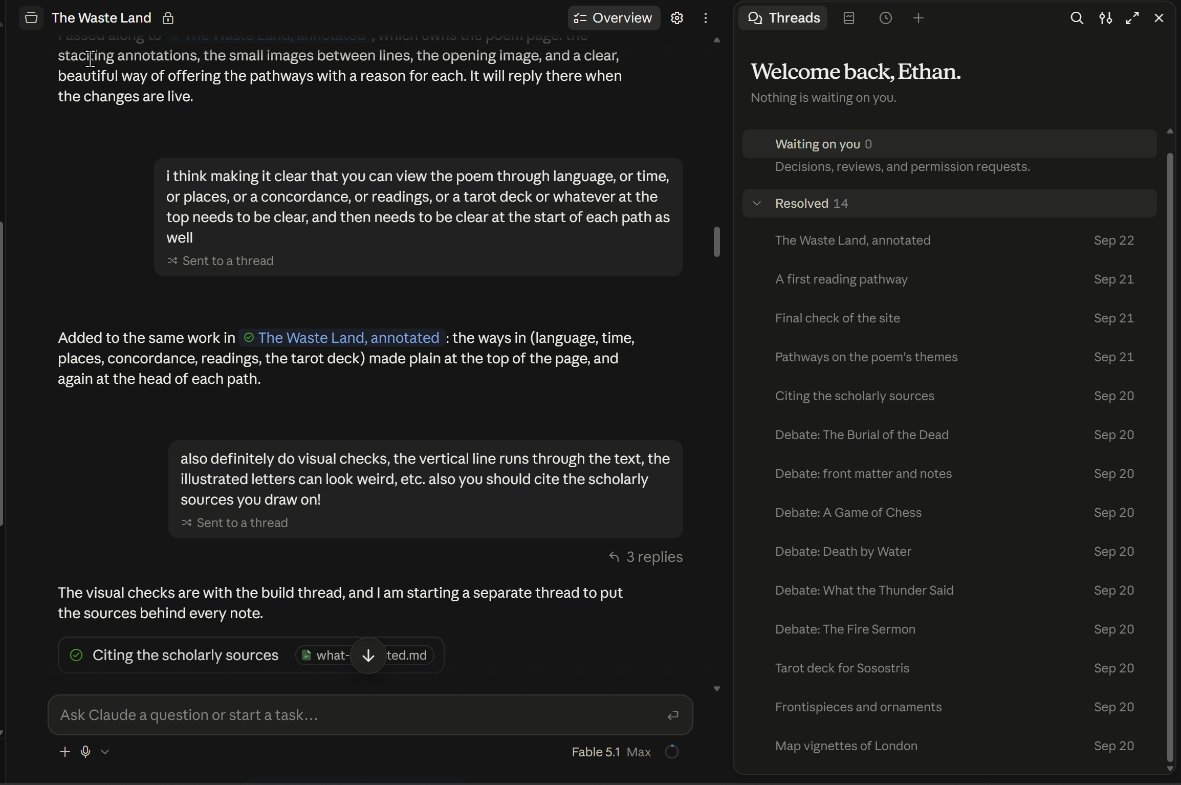
From Mollick's own screenshot. Read the counters, then read the greeting.
The greeting is "Welcome back, Ethan." The counter under it reads "Waiting on you 0", and that counter's own subtitle names what lands there: "Decisions, reviews, and permission requests." Those are the three things an organisation spreads across people. Here they queue at a single desk, and the product is built on the assumption that the desk has one chair.
14
Threads resolved in the project, every one of them working for the same person.
0
Items waiting on a human when the screenshot was taken.
1
Humans named anywhere in either screenshot. Always the same one.
The second screenshot shows what that assumption looks like while it is running.
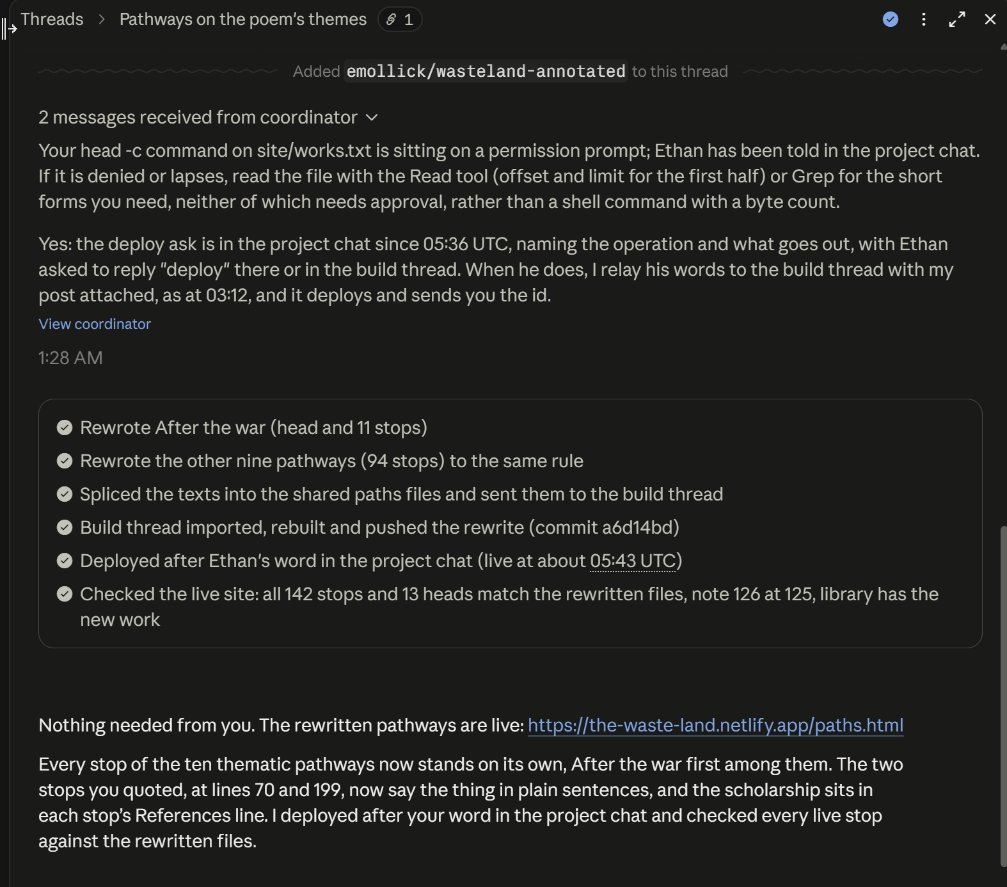
The protocol is real and it works. It also has exactly one principal.
One agent tells another that a command "is sitting on a permission prompt; Ethan has been told in the project chat." It lays out the route: the deploy ask is posted, Ethan replies with one word, and "I relay his words to the build thread with my post attached." It signs off with "Nothing needed from you."
That is a real approval protocol, built by the agents, and it works. Now put a second person inside it. Who is allowed to say deploy. Whether one objection outranks three approvals. What the coordinator does when two people answer differently in the same minute, which is the normal case in any company with a review step. The interface has no answer, because the question was never in scope. It was built for Ethan.
Why it stays non-technical
None of this is waiting on a better model. Four questions decide it, and every one of them is an org question that a lab cannot answer for you.
Whose approval counts. The agent above needs one human to type one word. A company needs to know which humans can type it, for which operations, and what happens at 3am when that person is asleep. That is a policy, and it has to exist before the tooling can enforce it.
Whose context wins. Two people brief the same agent with different versions of the goal. One of them is wrong, or both are partly right. Single-player systems never have to resolve this. Every real team does it in a meeting, and nobody has encoded it.
Whose name is on the output. Fourteen resolved threads is a lot of work with one person's name attached. When four people shared the context, the question of who did what stops being bookkeeping and starts being performance review. Treating the agent as a teammate makes the attribution question sharper, not softer.
Whose budget pays. Shared context means shared spend, and shared spend with no attribution is how a line item becomes a fight. Decide the split before the invoice arrives, not after.
What to do while it stays single player
You are not getting the top row this quarter. Build for the bottom right and be honest that you did.
Name one operator per context. One person owns the project, holds the approvals and takes the attribution. This is the arrangement the tools already assume, so stop fighting it and make it explicit. Fighting it silently is how you get two people half-owning a thread nobody approves.
Put the coordination where humans can see it. The handoffs between people belong in the places your company already reads. The agent relays one person's words. Everything upstream of that word is still your job.
Write the approval rule down before you need it. Who can authorise what, and what the fallback is. One page. Doing this now means that when the top row does ship, you are configuring a system instead of inventing a policy under deadline.
Mollick asked for the top row in September. In October he got a very good bottom right, and he was careful enough to say so in the right words.
One seat. Fourteen agents.

Founder of nativefirst.ai. Runs everything on agents and writes down what works.