Modal Hit $1B a Year. Sandboxes alone are $300M.
Modal crossed $1B annualized run rate in October. The sandbox product that runs model-written code is $300M of it, the size the whole company was in May.
On October 14 Modal announced it had crossed $1B in annualized run rate and raised a $750M Series D at a $15.75B post-money valuation, led by Accel.
The round is not the interesting number. This one is, and it sits four paragraphs down in the company's own post: sandboxes are a $300M run rate product on their own.
Five months earlier, at its Series C on May 21, the whole company had just passed $300M in annualized revenue. The line item that runs model-written code is now the size the entire business was in May.
$1B
Annualized run rate, growing more than 15x year over year. Company-reported.
$300M
The sandbox product alone. One third of the company, from isolated code execution.
3bn
Sandboxes spun up since the product launched in 2023.
What a sandbox is, and why it has a price
A sandbox is a machine that appears for a few seconds, runs code nobody read first, and disappears. Every agent that writes code needs one, because the alternative is running generated code next to your production data.
Erik Bernhardsson, who founded Modal, states the reason in nine words.

Bernhardsson
"LLMs write code now! And it has to run somewhere, isolated from everything else."
That sentence is the whole $300M. Somewhere is not free, and until this announcement nobody had published what somewhere costs at scale.
The million-sandbox test
In June the engineering team ran a million sandboxes at once and published the dashboard. All one million were created in under a minute, at an average of 18,518 per second.
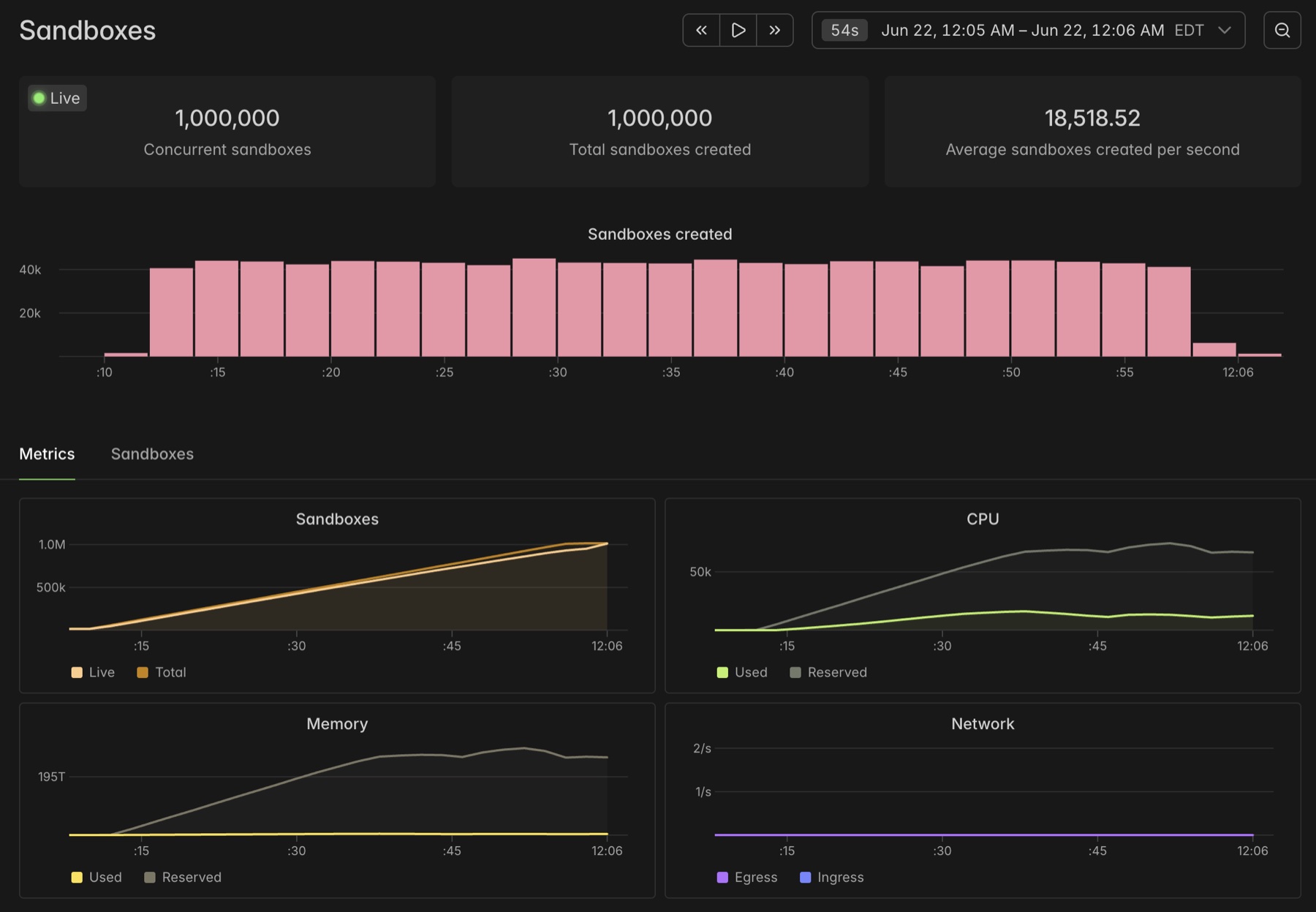
Modal's own dashboard, published in Scaling to 1 million concurrent sandboxes in seconds.
Scale on its own is a vanity number. The number that matters to anyone building on top of this is the one underneath it: how long a single sandbox takes to start, because an agent waits for it. They published that too, for ten thousand sandboxes sampled from the same test.
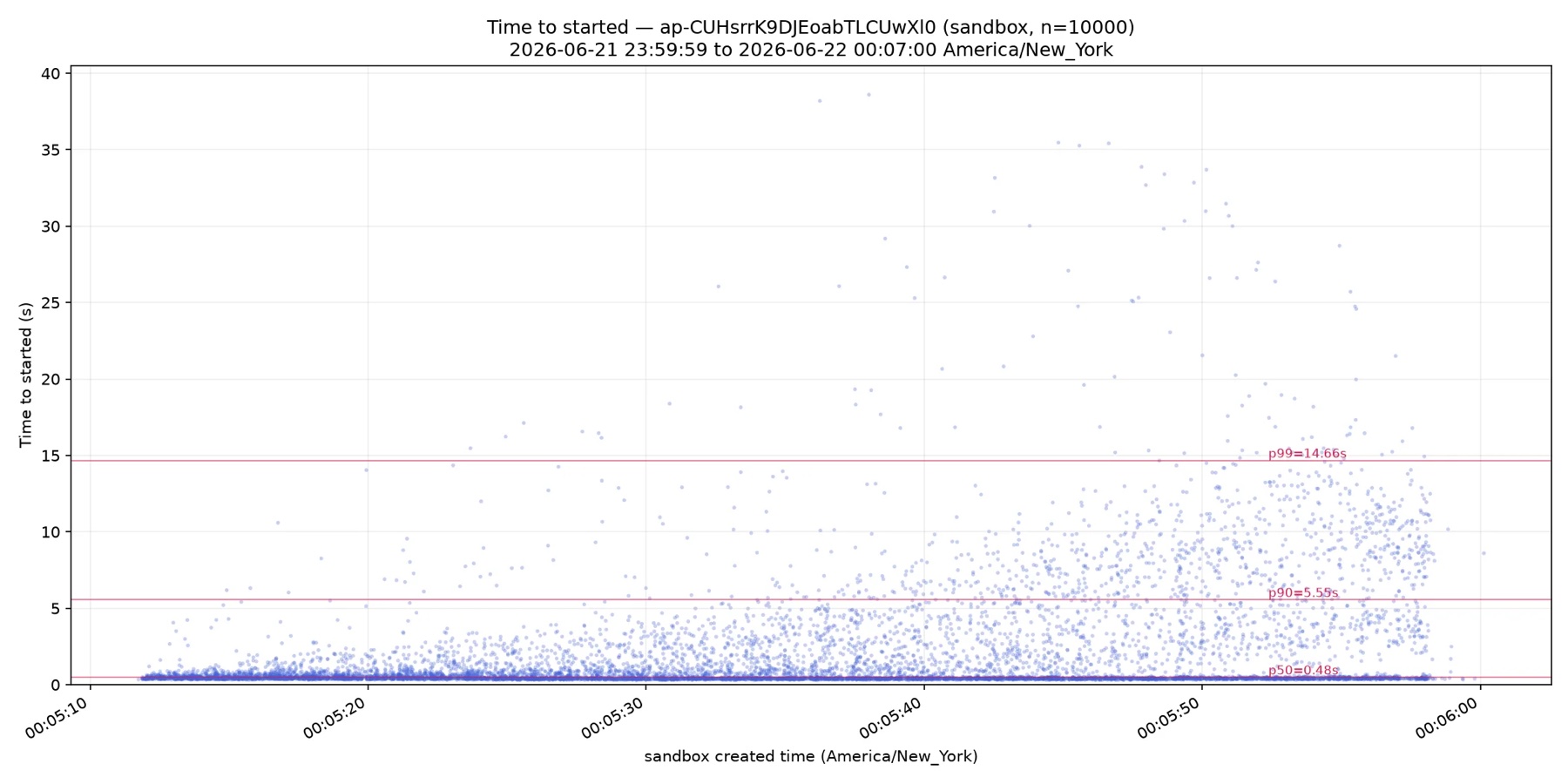
The honest version of a performance claim: the median, the tail, and the shape of the degradation.
Half a second at the median is the headline. The useful fact is the tail. One run in a hundred waits almost fifteen seconds, and the scatter gets worse the harder the system is pushed. If you fan out two thousand agent runs, you are not waiting for the median. You are waiting for the slowest one.
Who is actually paying for this
The customer list in the announcement reads as a census of the agent economy. Cognition, Ramp, Linear and Hebbia are named as building background agents. DoorDash's AI platform team moves applications from experiment to production on it. Runway generates video; Physical Intelligence, Generalist AI and 1X train robots; Chai Discovery and Achira do drug discovery; Suno makes music.
The clearest picture of what the money buys comes from a case study Modal published five days later, on the legal-AI company Legora. Eirik Drage Steen, a member of its technical staff, describes an experiment as 100 cases, 4 harness variants and 5 trials each. That multiplies out to two thousand runs, and each run gets its own sandbox booting the full application pinned to a specific commit.
Two thousand full application boots to answer one question about one change. That is not waste. It is what measuring an agent honestly costs, and it is the reason a sandbox line exists at all.
Why this number is worth more than a benchmark
A benchmark measures whether a model can write code. A sandbox bill measures whether anyone ran it.
Every coding benchmark this year has been argued over: saturated, gamed, run on contaminated data, scored by a harness that does half the work. None of those arguments touch $300M of billed execution. Somebody wrote code with a model, and somebody paid to put it somewhere isolated and press go, three billion times.
It is the clearest outside measure we have that agent-written code is not just being generated. It is being executed, in production, at a volume large enough to fund a company.
Three things to take from it
Budget the execution layer. If your agents write and run code, you have a compute line that scales with agent activity rather than headcount, and it is probably not in your AI budget. It was not in anyone's until this announcement gave it a size.
Check where your generated code runs today. If the answer is a long-lived container with your credentials in the environment, that is the real finding, and it is a security finding rather than a cost one.
Price your evals before you commit to them. The right number of eval runs is high, and Figure 2 is what high looks like on an invoice. Decide that deliberately rather than discovering it.
What to hold loosely
Every figure here is company-reported and unaudited, and the announcement does not define how run rate is calculated. The claim that TypeSafe's Jev served a trillion tokens on Modal in its first three days is a vendor's claim about a customer, and the first infrastructure-side volume figure anyone has published for Jev. The million-sandbox test is a test, run by the company, on a date it chose.
What is not in question is the direction of the number. $300M in May for the whole company, $300M now for one product inside it, and a capacity pool spanning more than twenty clouds to keep up. Modal runs 200-plus people across New York, San Francisco and Stockholm.
Model-written code has to land somewhere. Somewhere costs money now.

Founder of nativefirst.ai. Runs everything on agents and writes down what works.