The PlaybookAI Deployment

Lovable Apps Exposed Their Databases. 24,664 of them.

Crissy Field scanned 159,041 Lovable projects. 24,664 returned database records on first load with no login. It is the third time since 2025.

John TanNovember 3, 20265 min read

A Hamburg security firm called Crissy Field took 159,041 projects built with Lovable, found them through the Common Crawl web archive, and asked each one a simple question: what do you hand over to a stranger who has not logged in?

24,664 of them returned database records on the first page load. No account, no click, no interaction. The site simply sent the data because it was asked.

24,664

Sites returning Supabase records on first load, with no login.

10,560

Tables containing email addresses, across 7,403 of those sites.

3rd

Time this has been reported since March 2025. Same root cause each time.

Get the funnel right, because everyone is quoting it wrong

The number travelling on social media is 7,403, usually presented as 7,403 out of 159,041. That is wrong, and in the direction that makes it sound smaller than it is.

See Crissy Field’s method and caveats
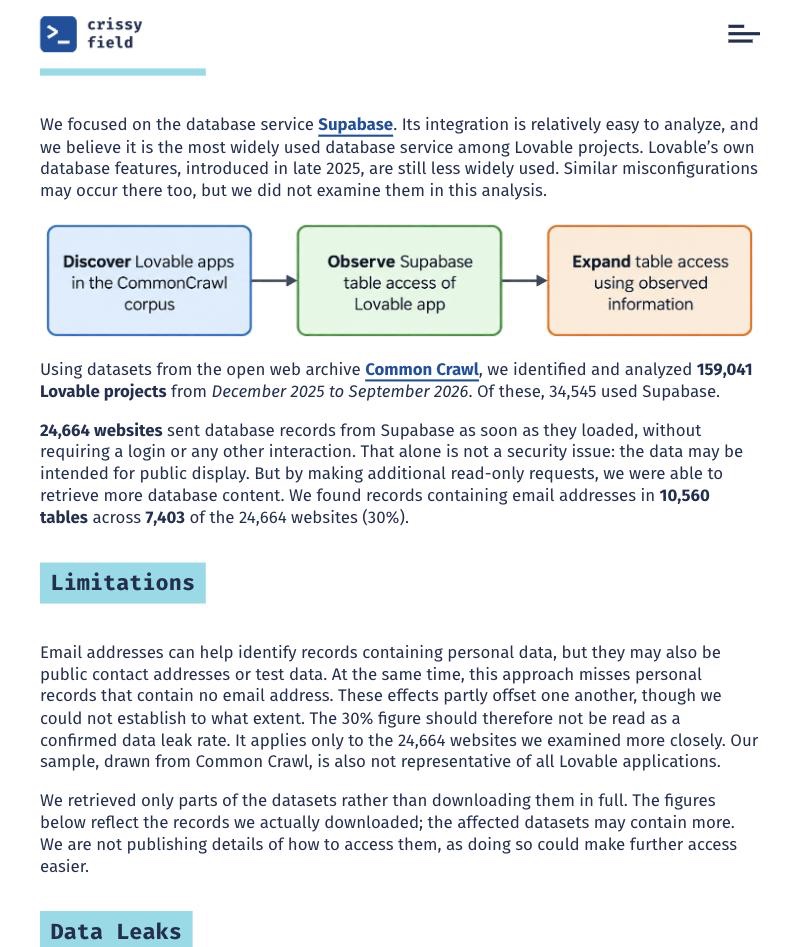
Screenshot of Crissy Field's research report. A three-step diagram reads Discover Lovable apps in the CommonCrawl corpus, Observe Supabase table access of Lovable app, Expand table access using observed information. Below it the text states that 159,041 Lovable projects were identified and analysed from December 2025 to September 2026, that 34,545 of these used Supabase, that 24,664 websites sent database records from Supabase as soon as they loaded without requiring a login, and that records containing email addresses were found in 10,560 tables across 7,403 of those 24,664 websites, or 30 percent. A Limitations section states that the 30 percent figure should not be read as a confirmed data leak rate and that the sample is not representative of all Lovable applications.
The method · Nov 2026Discover, observe, expand. The funnel and the limitations sit on the same page, which is how you can tell that the 7,403 everyone is quoting is the wrong number to quote.

The firm prints its own caveats directly beneath its own figures. Screenshot from Crissy Field GmbH’s research report (1).

Figure 1. The actual funnel
The exposed population is 24,664. The 7,403 is a subset.
PROJECTS ANALYSED USING SUPABASE SENDING DATA, NO LOGIN OF THOSE, HOLDING EMAILS 159,041 34,545 24,664 7,403 · in 10,560 tables The figure being quoted is 7,403 of 159,041. It is not. It is the slice of the 24,664 exposed sites where an email address turned up.
Figures from Crissy Field GmbH's own report on Lovable projects, read 3 November 2026. The firm cautions that the 30% rate is not a confirmed leak rate and that the sample is not representative of all Lovable applications. Figure by nativefirst.

What came out of those tables, in the firm's own description: more than 1,000 records with identity document details including passport numbers, all at a single service provider. More than 200,000 chat messages. A lifestyle forum with over 80,000 profiles. Tens of thousands of contracts. Ticket and restaurant records carrying payment information, with no count attached. In one case, a system that had sent 280,000 emails.

The firm is careful in a way the reshares are not. It says plainly that the 30% rate is not a confirmed leak rate, that the sample is not representative, that some of those email addresses are public contact details or test data, and that it could not establish whether anything had been misused. Keep those caveats. They are what makes the 24,664 credible.

The default did this, and it changed three days before the story broke

This is the part nobody reselling the headline has mentioned, and it is the only part that tells you what to do.

These apps talk to their database directly from the browser, using a public API key. That key being public is by design and is not a leak; it is in the source of every page. What stops a stranger reading the whole table is the access rules on the table itself. And until recently, a new table in Supabase was exposed through the data API automatically, with no explicit grant required.

Supabase changed that. New tables are no longer auto-exposed, a change logged in April 2026 and enforced across all existing projects on 30 October 2026. The research window ran from December 2025 to September 2026, which sits entirely inside the old permissive behaviour. The report landed three days after the enforcement date.

So the honest account is neither "Lovable is insecure" nor "those builders were careless." A platform default was permissive, tens of thousands of apps were generated on top of it, the default has since been tightened for new tables, and existing tables keep the grants they already had. Which means the apps found in this research stay open until each operator goes and closes them, one at a time.

Third time, same answer

The reason to take this seriously is not the size of the number. It is that this is the third public instance of the same failure in twenty months.

Figure 2. Twenty months, one root cause
The finding keeps changing scale. The answer does not.
WHEN WHAT WAS FOUND THE ANSWER GIVEN Mar 2025 CVE-2025-48757, rated 9.3 Disputed. Customer's data, Feb 2026 18,697 records in one app Scan exists. Acting on it "default insufficient RLS policies" customer's responsibility. 870 with full personal data is the user's discretion. Nov 2026 24,664 sites, no login needed Industry-wide issue. Security 7,403 holding email addresses is a shared responsibility. One app, then eighteen thousand records, then twenty-four thousand sites. The scale moves by orders of magnitude every time. The answer has not moved at all.
Compiled from the 2025 CVE record and the researcher's disclosure timeline, The Register's reporting of 27 February 2026, and Crissy Field's report, read 3 November 2026. Lovable's November position is reported speech via Handelsblatt, 2 November 2026. Figure by nativefirst.

Lovable's position has been consistent and it is not unreasonable: the platform ships a free security scan before you publish, acting on it is the builder's choice, and misconfigured access rules show up in hand-written software too. All of that is true. It is also not a plan, because the people generating these apps are by design the people least equipped to audit a database grant.

The same company's story a year ago was going from 11 internal apps to 80, which is the genuine upside of this and the reason nobody should read this post as an argument against building that way. The lesson is narrower. When generation gets cheap, the thing that does not scale with it is review.

What to do before Friday

Query your own app the way a stranger would. Open it in a private window, find the API call the page makes on load, and run it with no session. If it returns rows, you have the same problem these 24,664 have. This takes ten minutes and it is the only test that counts.

List your tables and read their grants, not your policies. A policy describes intent. A grant describes what the API will actually serve. The April change only protects tables created after it, so anything older carries whatever it was given on the day it was made.

Treat "the platform has a scanner" as a smoke alarm, not a sprinkler. It tells you something; it does not fix anything. If the people shipping your internal tools cannot read its output, somebody who can has to be in the loop before publish, not after a researcher calls.

Count what is reachable, not what is sensitive. This is the same mistake as the supermarket refrigeration panels sitting on the public internet. Nobody decided to expose them. Each one was connected for a good reason and never revisited, and the inventory is what nobody had.

Twenty-four thousand apps are answering questions nobody is authorised to ask. Almost none of their owners know, because nobody ever asked.

Query your own app.

Portrait of John Tan
John Tan ↗

Founder of nativefirst.ai. Runs everything on agents and writes down what works.

Sources
1Crissy Field GmbH (Hamburg) research report on Lovable projects, read 3 November 2026: 159,041 projects analysed via Common Crawl datasets over a December 2025 to September 2026 window; 34,545 using Supabase; 24,664 websites transmitting Supabase records on first load with no login or further interaction; 7,403 of those 24,664 holding records containing email addresses, across 10,560 tables. Read-only requests only; the firm states it is not publishing details of how to access the data. The report itself carries no publication date and states that it presents more recent figures than the Handelsblatt article of 2 November 2026.
2Findings described in the same report: more than 1,000 records containing identity document details including passport numbers, at a single service provider; more than 200,000 chat messages; a lifestyle forum with more than 80,000 profiles; tens of thousands of contracts; ticket and food-sales records carrying payment information, with no count given; one case of 280,000 emails sent. The firm's own caveats: the 30% figure "should therefore not be read as a confirmed data leak rate," the sample "is also not representative of all Lovable applications," some email addresses "may also be public contact addresses or test data," the method "misses personal records that contain no email address," and it could not establish whether any data had been misused.
3The research was conducted jointly with Handelsblatt, which published on 2 November 2026 (Lina Knees). Lovable's response in this story is reported speech via Handelsblatt, attributed to its CISO: that this is a known industry-wide configuration issue and that "Security is a shared responsibility." The Handelsblatt article body is paywalled and was not read directly for this post; no first-party Lovable statement on this research was found.
4Supabase changelog, "Breaking Change: Tables not exposed to Data and GraphQL API automatically," entry dated 28 April 2026 and enforced across all existing projects on 30 October 2026: new public tables are no longer automatically exposed through the Data API without an explicit grant, while existing tables keep their grants. The public anon key is by design part of the source of every page and is not a leaked credential. supabase.com/changelog
5Prior instance, March to May 2025: CVE-2025-48757, disclosed by researcher Matt Palmer on 29 May 2025, CVSS 9.3 critical, CWE-863, described as arising "due to default insufficient Row Level Security (RLS) policies on client-controlled direct database requests." The CVE record carries Lovable's dispute: "this is disputed by the Supplier because each individual customer of the Lovable platform accepts a responsibility over protecting the data of their application." Lovable added a pre-publish security scan in April 2025. cve.org
6Prior instance, February 2026: The Register, 27 February 2026 (Connor Jones), reporting researcher Taimur Khan's finding of 18,697 user records exposed in a single Lovable-built application, including 870 with full personal data, attributed to row-level security and role-based access not being explicitly implemented plus inverted access-control logic in an authorisation function. Lovable's CISO is quoted there stating that a free security scan runs before publishing, that implementing its recommendations is "at the discretion of the user," and that "In this case, that implementation did not happen."
7Note on mechanism: Crissy Field's report does not itself use the term Row Level Security. It describes retrieving further database contents through supplementary read requests, notes that "faulty access rights are found in many applications, whether programmed by humans or created with AI," and adds that with Lovable "databases are connected according to recurring patterns." The RLS attribution in this post rests on the 2025 CVE record and The Register's February 2026 reporting, which name it explicitly.

Read next

AI is moving really fast. Keep up.

Read the Playbook