a16z published its Charts of the Week on August 23 with a line that should reorganise how you think about AI rollout: "AI power users are showing up outside tech."
Then the numbers. Growth in Codex adoption since February 2026, by function. Legal up 108x. Sales up 41x. Recruiting up 41x. Marketing up 26x. Healthcare up 24x.
Codex is a coding tool. The fastest-growing adopter of a coding tool is the legal department.
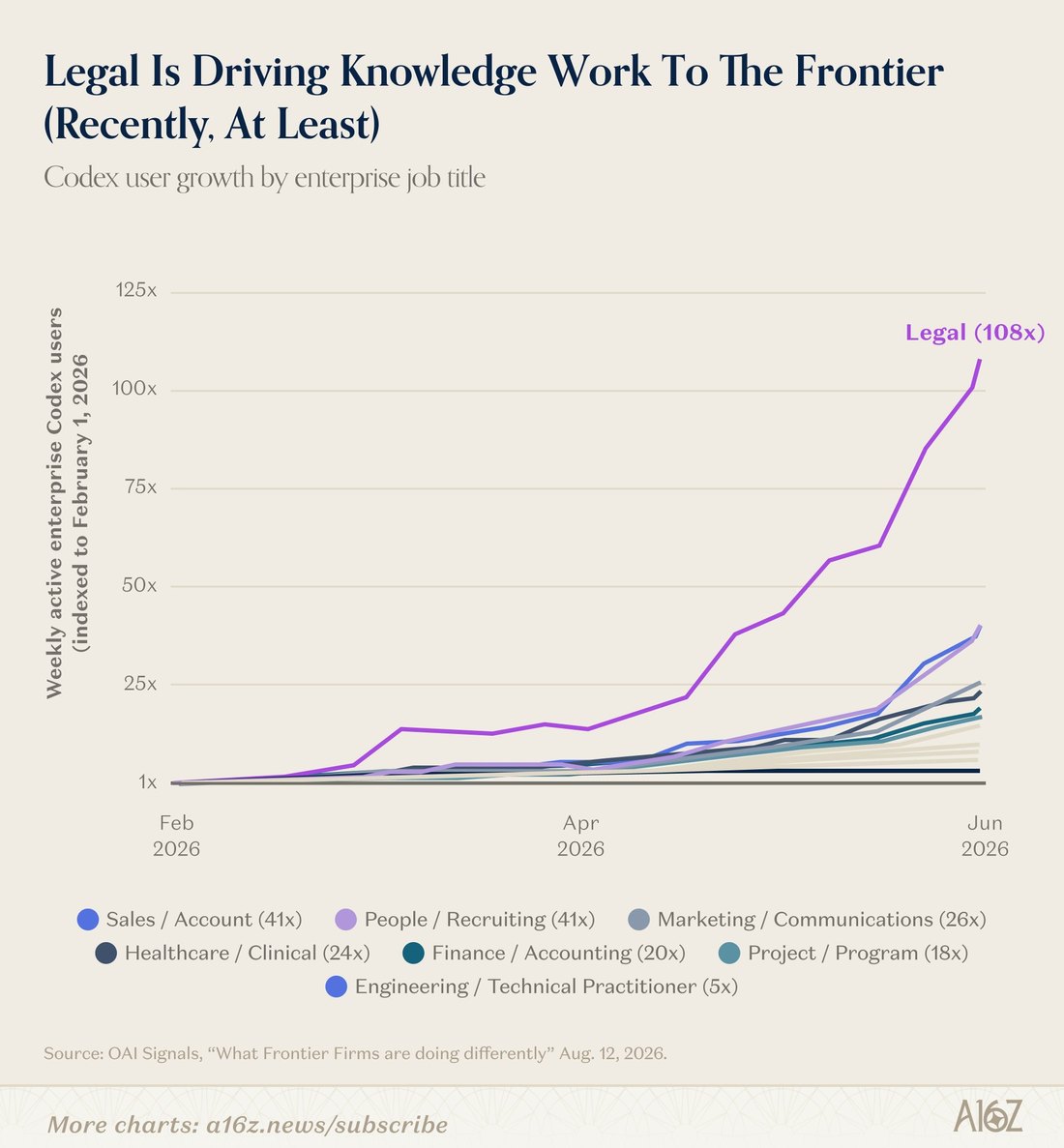
a16z on OpenAI data. Chart from a16z on X (1).
Read the caveat before you quote the number
a16z flagged this itself, and it belongs in any honest use of the figure: "Query how much of this shift is driven by the broader Codex rollout." A 108x multiple off a February base of nearly nothing is a big multiple off a small number, and part of it is Codex simply becoming available to people who were never offered it before.
That does not deflate the finding, it locates it. The claim worth making is not "legal departments out-engineer engineering." It is that when a general-purpose agent tool reaches functions outside engineering, the take-up is immediate and steep, and the ranking is not the one anyone planned for.
The refinement that matters: adoption is bimodal
The same article carries a second dataset that changes the shape of the whole AI-adoption conversation, and almost nobody quoted it.
Output tokens have roughly doubled at the typical firm over the past year. Meanwhile the top decile of enterprises has increased output by more than 17x since April 2025. That leaves an eightfold gap in token output between the typical and top-decile enterprise. In Information, meaning tech, the gap is almost twelvefold, and the top decile is putting out 32.5x as many tokens as it was a little over a year ago.
And the power users are not getting there by chatting more. Plug-in adoption in the top decile runs about 2x the typical firm. Skills adoption runs about 6x.
This is why two credible people can look at the same year and disagree completely. Austen Allred, the same week:

Allred
"AI adoption is sooooo much slower in most companies than you would expect it is reading X."
He is right about the median. The 108x is right about the tail. Both are the same distribution.
And the vendor now agrees about the median, which removes the last easy objection to this framing.

Altman
"I thought when we got to GPT-4, which was back in 2023, that very quickly after that there was going to be much more disruption, software businesses up for grabs right away."
When the CEO of OpenAI says the economy adapted more slowly than he expected, "your competitors are further behind than the timeline implies" stops being a consultant's framing and becomes the vendor's own account of the last three years.
Growth is outside engineering. Spend is still inside it.
Put the a16z function data next to Menlo Ventures' departmental AI spend, which Marty Kausas surfaced three days later, and you get the gap that actually matters.

Kausas
"There's only one function that's really taken off which is AI coding. Every other department is still early."
So: the steepest adoption growth is in legal, sales, recruiting, marketing and healthcare. The budget is still almost entirely in engineering. Those two facts describe the same organisation, and the space between them is where AI programmes stall.
The mechanism is not mysterious. Individual adoption is bottom-up and free to start, so it shows up as a 108x multiple in a usage chart. Installed workflow is top-down and costs money, so it shows up as a budget line, and the budget line has not moved outside engineering yet. A legal team using Codex on its own initiative is a person with a tool. It is not a function that has been redesigned around the tool, and the difference is the whole ROI question.
What to do with this
Find out which decile you are in, not whether you have adopted. The useful internal question is not "do we use AI." It is "what is our token output per employee against the top decile in our industry." One of those numbers gets you a yes and no information. The other tells you whether you are pulling away or being pulled away from.
Follow the individual adoption to pick the function. Somebody in your legal, sales or recruiting team is already three months into using an agent tool nobody bought them. That is free market research about where the workflow will take, and it beats a prioritisation workshop. Rank the functions by payback speed, then check the ranking against who is already quietly doing it.
Treat Skills as the gap, not the licence. Skills adoption is 6x higher in the top decile. That is the difference between people who chat with a model and people who have written down how their work is done in a form an agent can execute. Nobody closes a 6x gap by buying more seats.
Discount your own multiple. If your usage is up 40x since February, some of that is availability rather than transformation, exactly as a16z warns about legal. The number that survives scrutiny is output per person against a peer, not growth against your own low base.
The story everyone told about 2026 was that AI adoption was disappointing. The data says adoption is not disappointing, it is bimodal, and the average is a statistic nobody actually occupies.
Find your decile.
Keep reading.
Teardowns, benchmarks and playbooks on building AI-native products.
Browse the Playbook →