Karpathy Mined 43 Million Hacker News Comments for the videos it keeps recommending.
Andrej Karpathy had Claude read twenty years of Hacker News and pull out 6,454 videos. It took about two hours. The signal had been public all along.
 Hacker News
On November 1 Andrej Karpathy, who ran AI at Tesla and was a founding member of OpenAI, posted a weekend project. He was annoyed with YouTube's recommendations, so he had Claude read twenty years of Hacker News and pull out the videos people there keep recommending.
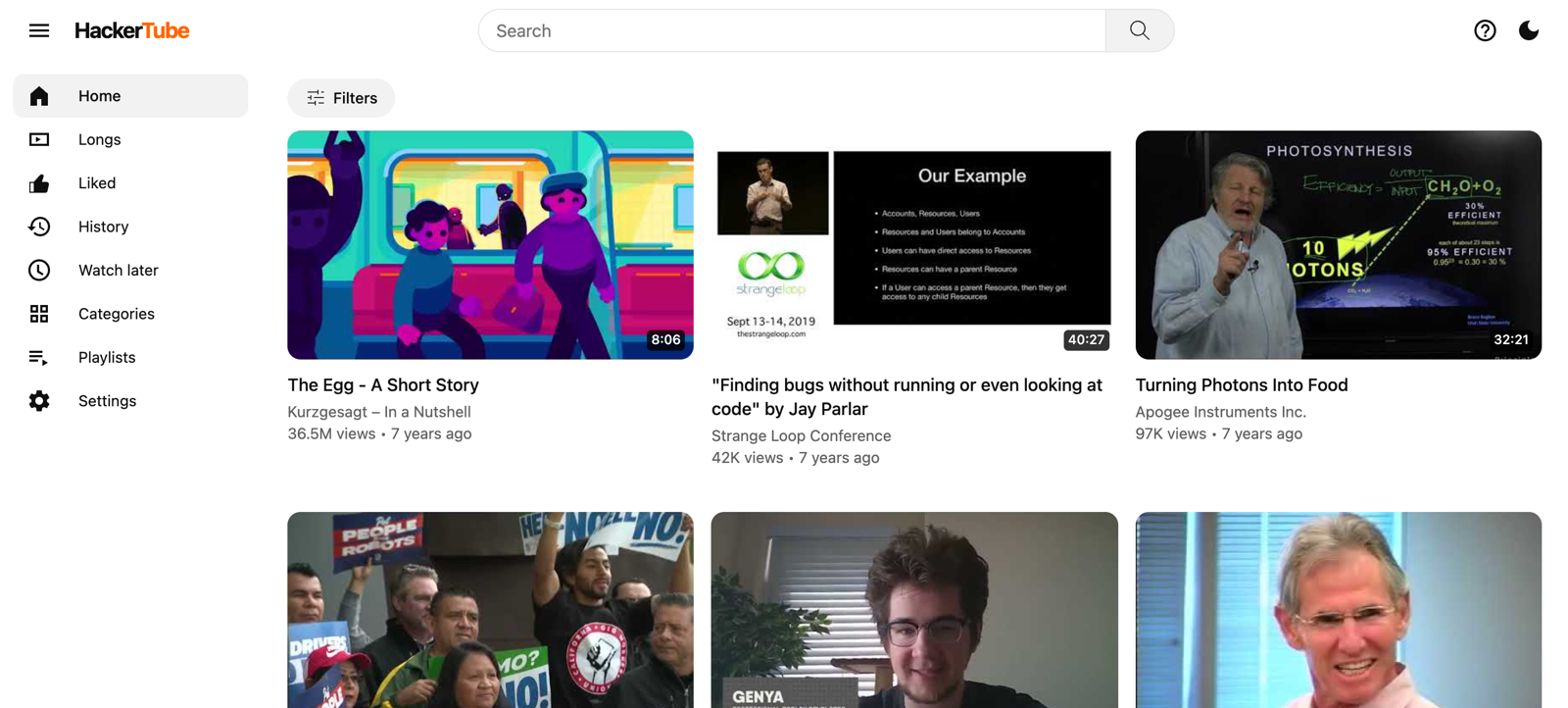
What he built · hackertube.org, captured 13 November 2026The first row on the home page: a 36.5-million-view Kurzgesagt short beside a 42,000-view Strange Loop talk, ranked the same. Open it yourself.

Karpathy
"Weekend hack: HackerTube. I was annoyed with YouTube's recommendations so I had Claude filter down 43M comments over 20 years of HN to 6,454 videos that keep being recommended. Significantly better viewing experience, ~2 hours with Opus 5.5"
43M
Hacker News comments read, spanning twenty years of the site.
6,454
Videos that came out the other end, at hackertube.org.
~2 hours
Build time, with Opus 5.5. Not the weekend the label suggests.
What he actually built, and what he did not claim
He did not build a recommender. He did not train anything. He did not beat YouTube's algorithm, and he never said he did. Read the post again: YouTube is the thing that annoyed him, and the claim at the end is "significantly better viewing experience." That is all.
What he built is a list. Twenty years of people typing "watch this" in a comment thread, counted and sorted. The work was extraction, not learning, which is exactly why it took two hours instead of two quarters.
That distinction is the whole economics of it. Training a recommender means collecting labelled preferences, which means having users first, which means you cannot start. Extraction means the labels already exist in prose and somebody just has to read all of it. Reading 43 million comments was impossible at any sensible price until recently and is now an afternoon. Nothing about the recommendation problem got easier. The cost of reading did.
Worth noting which model he reached for. Not the flagship: he names Opus 5.5, which is the tier Anthropic's own documentation now tells you to start with. A job that is mostly reading does not need the most expensive thing on the menu, and the person who built this knew that.
The labels are the whole argument
Open the site and the videos carry tags that give the game away. "Hidden gem: loved on HN, little-watched on YouTube." "Deep cut: recommended on HN, rarely surfaced." "An HN classic."
Those are not decorations. Each one names a measurable gap between two signals: how often a video gets recommended by people on one site, and how often it gets surfaced by the recommendation engine on another. A 42,000-view conference talk sitting beside a 36.5-million-view short film is the gap made visible.
YouTube has every signal that exists. Watch time, rewatches, pauses, a billion users, years of optimisation. Hacker News has no recommendation engine at all. The comparison is not close to fair, and the comment section still held something the engine could not surface, because the two are optimising for different things and only one of them was ever trying to find you a good talk from 2014.
Twelve hours later, somebody did it again
Within half a day another builder shipped ShowReel, the same trick aimed at a different slice of the same corpus: product demos submitted to Show HN over the years, pulled out and curated the same way.
That is the part worth sitting with. If the asset had been Karpathy's skill, the second version would have taken another weekend and somebody of similar ability. It took twelve hours, because the asset was never the builder. It was the corpus, and the corpus was public the entire time.
The question this asks of your company
Twenty years of recommendations sat in a public comment section and the cost of turning them into a product was two hours of inference. Not because the model is magic, but because somebody finally pointed it at a pile of text nobody had bothered to count.
So: what is your pile? Every company has one. Support tickets where customers said what they actually wanted. Sales call notes. Closed issues. Six years of specs, which is precisely what let Ramp build its own code reviewer in two weeks. Slack threads where the real decision got made before the document was written.
Three questions, in order, and the third is the one that stings.
What has accumulated here as a byproduct? Not the data you collect on purpose, which you are already using. The exhaust: the stuff generated while doing something else, that nobody designed as a dataset.
Can a machine read it where it sits? This is the whole bottleneck. Hacker News comments are public, plain text, and already structured by thread. If your equivalent is locked in a tool with no API, or in PDFs, or in people's heads, your two hours becomes two quarters and the project dies in planning.
What would counting it reveal that you currently guess at? HackerTube's answer was a ranked list of 6,454 videos. Yours might be which objection actually kills deals, or which feature request keeps coming back under different words. You are probably arguing about this in meetings using anecdotes.
Karpathy did not have better data than YouTube. He had data nobody had read.
The signal was public.

Founder of nativefirst.ai. Runs everything on agents and writes down what works.