In August 2026, Instinct raised $350 million at a $2.5 billion valuation.
On September 28, one month later, it closed $1 billion at $10 billion. A 4x step-up in thirty-one days.
In the same window it has never published a user number. Not once. TechCrunch, covering the $10B round, noted plainly that the company "has not shared its user numbers or any growth metrics."
31 days
Between the $2.5B mark in August and the $10B mark on 28 September. Both confirmed.
4x
Valuation step-up inside that month, on no published usage figure.
Zero
User numbers the company has ever released. Ratios and event counts only.
Then on October 29, OpenAI shipped the feature Instinct was built around.
What ChatGPT shipped, and why it lands here
The announcement was three sentences and it describes Instinct's product.
From the official ChatGPT account, October 29: "By popular request, you can now text your dot. Give it a task to take off your plate or something to keep an eye on, using text, photos, or even voice notes. It will text you proactively with relevant updates. Safe, secure texting via iMessage or RCS."
Proactive outbound messaging was the thing that made Instinct feel different from a chat window. An agent that texts you first, without being opened, is a different relationship to software than one that waits in a tab. We have written the explainer on exactly that.
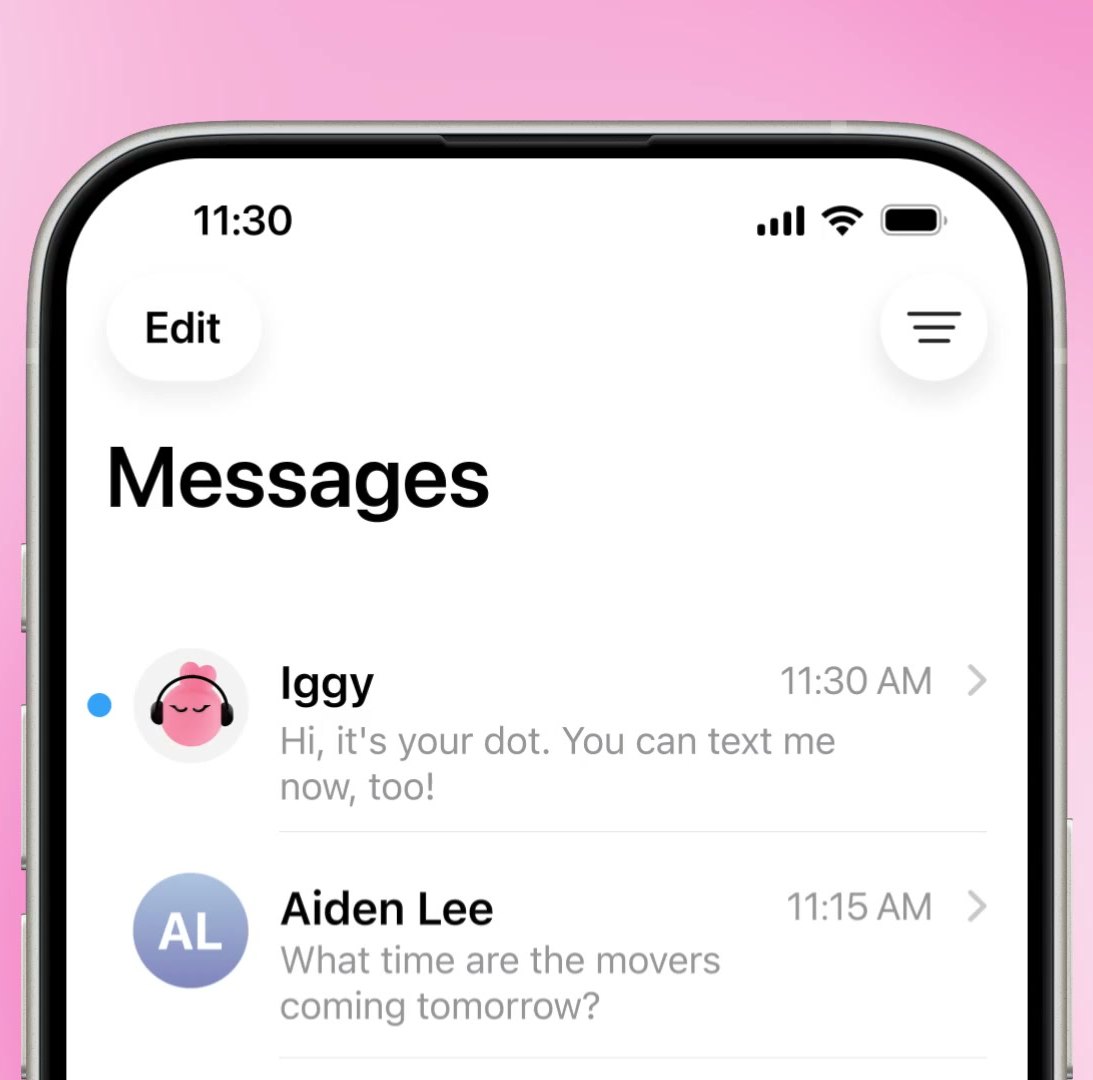
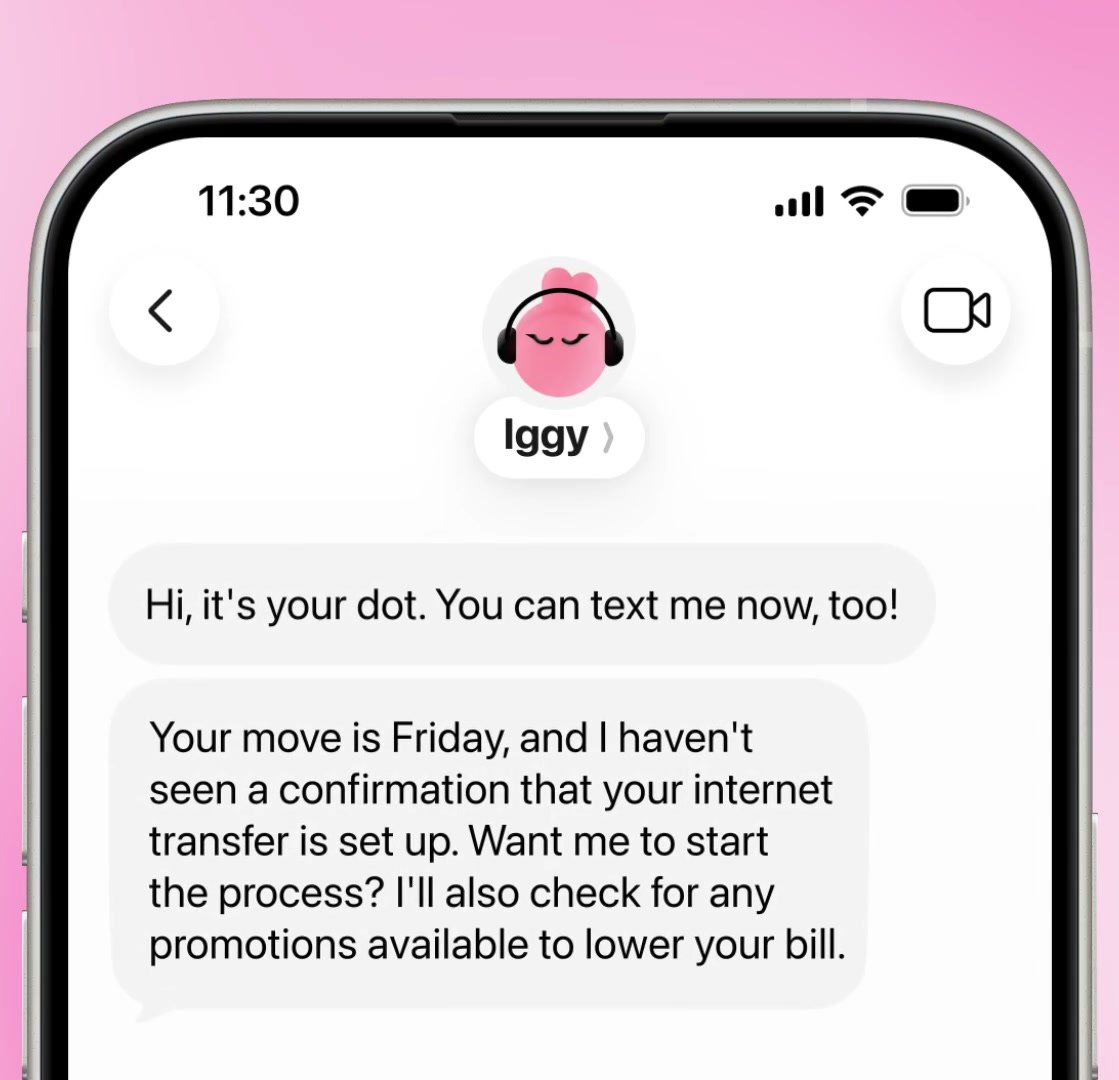
Stills from OpenAI's own announcement video, 29 October 2026.
Andrew Wilkinson, who invests in this category, quoted the announcement with two words and a headstone.

Wilkinson
"RIP Instinct 🪦"
That is an investor being funny on the internet, not an obituary. Instinct shipped an iPhone Action Button shortcut three days before, and Jane Manchun Wong found personal-finance integrations in the app the day after, letting users connect bank, card, investment and loan accounts through Plaid. The company is not standing still.
But the joke works because everyone recognised the shape. A startup priced on a feature, and the largest distributor in the category shipping that feature.
The gap between what is priced and what is disclosed
Here is the thing worth looking at properly, because it is the part that generalises past this one company.
Read the right-hand column again. Each figure is real, and not one of them has a denominator. "35% of our users" is a share of a number nobody outside the company knows. "Coordinated over 300k+ times" counts agent-to-agent events, which is a usage metric only if you already know how many agents there are.
A company can run this way. Plenty do. But it means the $10 billion mark rests on investor conviction rather than on anything a reader can check, and conviction is the thing a competitor's launch moves.
There is a reported $30B, and we are leaving it out of the headline
On October 27, an X post claimed Instinct is "currently raising @ $30b" and laid out the ladder as $100M to $500M to $2.5B to $10B to roughly $30B in under a year.
If true that is one of the fastest value ladders ever built. It is one post, from one person, with no outlet behind it and no company confirmation. The brain's own record is instructive here: a $2.25B figure circulating in September 2026 turned out to be a relay error, while a "seeking $10B" rumour from the same week turned out to be correct eleven days later. Rumours in this category are right often enough to be dangerous and wrong often enough to be worthless.
So it goes in the body, labelled, and not in the headline. The two confirmed marks are enough.
The part that is actually about your company
Strip out the valuation theatre and there is a repeatable mechanism here, and it is not unique to consumer agents.
Instinct's differentiator was a behaviour, not a technology. Texting you first is a product decision about when an agent is allowed to interrupt. It requires no moat-grade research. Once it was proven desirable, the company with a billion existing users could ship it in a quarter, and did.
This is the same lesson Muse has been teaching from the other direction all autumn: Meta's free assistant topped the app stores and outscored Instinct on the Assistant Benchmark while Instinct raised at $10B. The paid startup and the free incumbent converged on the same feature set, and the startup is the one carrying a valuation that needs the gap to persist.
If you are building anything in the agent layer, the question the October 29 announcement asks is blunt. Is our advantage a behaviour an incumbent can copy in a quarter, or a position they would have to rebuild their company to reach?
Memory is the usual answer, and it is a better one. Harry Stebbings, in October, pointed at exactly that: what Instinct and Muse "have nailed" is the memory layer, which is rare today and will be common soon. Common soon is the operative half of that sentence.
What to watch
Three things will settle this inside six months, and none of them is the next valuation.
Whether a user number ever appears. A company with good retention eventually publishes it. A year of ratios without a denominator is itself a datapoint.
Whether the finance integrations hold. Connecting bank, card and investment accounts through Plaid is a far deeper hook than proactive texting, and it is the kind of thing OpenAI moves more slowly on. That is a real attempt at a position rather than a behaviour.
Whether the agents can still transact. A user reported in October that after a month, the stores had started turning the bots down. A personal agent that cannot complete the errand is a very expensive notification system.
Keep reading.
Teardowns, benchmarks and playbooks on building AI-native products.
Browse the Playbook →