Fable 5.2 Finished Fermat's Last Theorem. Opus 5.5 is still at 26%.
The chart shows the restart that finished it.
 Fable 5.2
Anthropic released Claude Fable 5.2 and Claude Mythos 5.2 on 9 November, and published one chart that is worth more than the launch copy around it.

"A team of 1,000 Fable 5.2 agents fully formalized Fermat's Last Theorem in 30 hours, translating the proof into a language a computer can check step by step. With the same setup, Opus 5.5 completed only 26% in 18 hours, and barely made any more progress after 30 hours."
Same harness. Same task. Same thousand agents. One model finished and the other stopped at a quarter.
What was actually formalized
Fermat's Last Theorem says that no three positive whole numbers a, b and c satisfy an + bn = cn for any whole number n greater than 2. Pierre de Fermat wrote it in a book margin in 1637 and claimed a proof that would not fit there. Nobody produced one for the next three and a half centuries. Andrew Wiles finally did in the 1990s, patching a gap with Richard Taylor, and the result runs to over a hundred pages of modern number theory that perhaps a few hundred people on earth can check.
That is the part worth holding onto, because the agents did not prove the theorem. Wiles did. What the agents did is formalize it: rewrite every step of the proof in Lean, a language in which a computer verifies each line against the ones before it. When a formalization compiles, the proof is correct, and no human has to be trusted or even consulted.
Formalizing is slow, unglamorous and enormous. It is the mathematical equivalent of porting a legacy system, where nothing new gets invented and everything must be exactly right. Anthropic makes the point themselves: mathematicians do not do it because it takes too long, which matters more now that models generate results humans struggle to verify by hand.
The comparison Anthropic buries is better than the one it leads with. An unreleased research version of Claude formalized the same theorem earlier this year and took eleven days, using a purpose-built harness and guidance from a human researcher. Fable 5.2 did it in thirty hours from minimal prompts, with no mathematical references, building its own coordination as it went. It used a third of the action tokens and produced a proof seven times shorter.
Read the chart, not the sentence
Anthropic published the completion curve with the claim, and the curve says something the sentence leaves out.
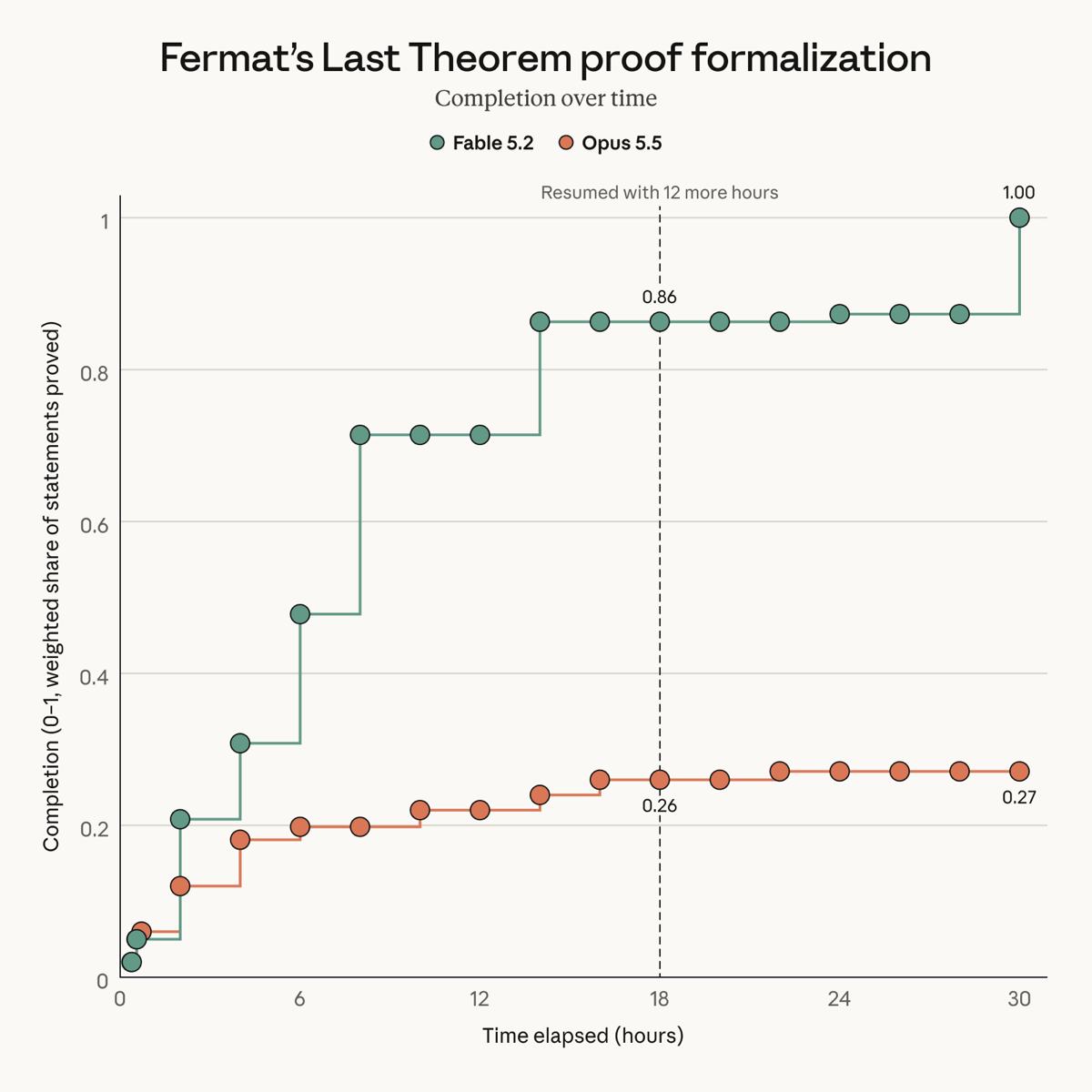
Three things are visible that the quote does not say.
Both models plateau. Fable 5.2 reaches 0.86 at around hour 14 and then holds there, dead flat, for four hours. Opus 5.5 reaches 0.26 at hour 16 and holds flat for fourteen. Neither run degrades. They simply stop producing.
Both runs were restarted, not just the winner. The dashed line at hour 18 is the point where, in Anthropic's own words, both teams resumed from their last save with twelve more hours. Fable 5.2 did not grind from 0.86 to 1.00. It sat flat, got a restart, and then closed the last fourteen points.
The same restart did nothing for Opus 5.5. Identical twelve hours, same saved state, and it moved from 0.26 to 0.27. One point. The restart is not what separates them. What separates them is that one model had somewhere left to go.
0.86 when the first budget ran out, 1.00 after twelve more hours
0.26 at the same point. The extra twelve hours bought one point.
What this says about running a fleet
The headline reads as a model comparison. The chart is closer to an operations report, and it describes something anyone running agents at volume has already seen.
A long agent run does not fail loudly. It goes quiet. The curve flattens, the processes are still alive, tokens are still being spent, and nothing new is being produced. This Playbook has been counting that problem from the other end: Perplexity has ten thousand teammates and a thousand that did anything yesterday. A flat curve is the same fact at a smaller scale.
So the operator question is not which model is cleverer. It is what you do at hour 14, when the line goes flat. Anthropic restarted both teams from their last save, which is the right move and also an admission: the flat line was not something the agents resolved on their own.
And a restart is only worth buying if there is somewhere left to go. Twelve more hours bought Fable 5.2 fourteen points and bought Opus 5.5 one. Both looked identical at hour 17: a flat line and a live process. A fleet that cannot tell a paused run from a finished-but-not-done run will keep paying for the second kind, and that judgement sits above the agents rather than inside them. Brian Armstrong gave that layer a name two days ago.
The rest of the release
Fable 5.2 is live in the Claude Platform and Claude Code at $8 and $40 per million tokens, down from $10 and $50, and Anthropic says it is up to 30% faster than Fable 5.1. A frontier release that costs 20% less than the model it replaces is the second story of the day, and it deserves its own edition.
Mythos 5.2 came with a claim of its own: a new way to predict the structure of a gene-therapy capsid, accurately modelling 28 of the 34 it attempted. Anthropic also says Fable 5.2 designed three working electronic devices from a one-paragraph prompt.
Those are vendor claims on launch day, published without an external eval, and they should be read that way until somebody reproduces them. The Fermat chart is the exception, and only because it shows its own failure mode.
Watch for the flat line
If you are running long agent jobs, the number to instrument is not completion. It is time since the last unit of real progress, per run. Anthropic's chart puts that interval at roughly four hours for the model that finished and fourteen for the model that did not.
Whoever is watching that interval is doing the job the chart is actually about.
Watch the flat line.

Founder of nativefirst.ai. Runs everything on agents and writes down what works.